

.
All those who’ve worked me on special fabrications will be aware of my fascination with magnets (no tools needed!) and I’ve always puzzled about where we get our magnets from. So I decided to find out. I wish I hadn’t. This is where a random Google search can take you to some very dark places.
What I didn’t know is that magnets for electronics circuitry come from rare earths – and I thought I knew about rare earths, but not the half of it. I also had never come across the term ‘Sacrificial Zone’.
It’s reckoned that global demand for rare earths will ‘explode’ by 300- -700% by 2040. This is what happens when we choose not to look. Back in 1980s Deng Xiaoping said that rare earths would be China’s version of ‘oil in the Middle East’.
Myanmar is a Sacrificial Zone. It means that the country is destroying itself for the benefit of the rest of the world. While many countries, including China, have introduced new environmental laws to protect their own lands, that has simply opened the back door into other countries where there is no such protection.
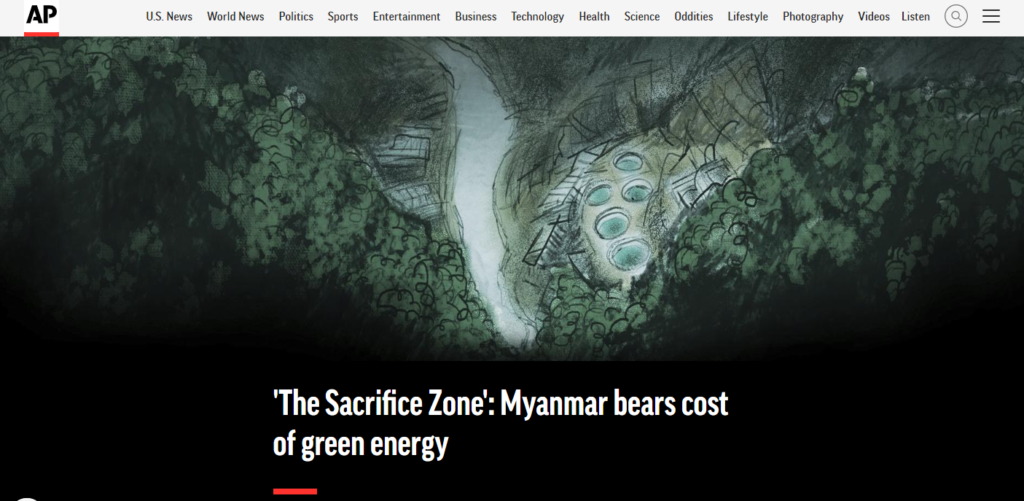
Here’s an article from Associated Press for you read (on the screen of your rare-earth-rich device . . . just saying):
.
.
This YouTube video, from the AP article, includes the recording of a Militia Leader of Myanmar’s Border Guard Force. He tells a group of villagers; “You, village leaders, should solve this issue. Otherwise, I will have to start shooting and killing people from now on.”
.
.No, this isn’t really about the lighting industry, though we have to bear our share of the situation. because it’s an EVERYONE problem. All those of us who use and rely on modern electronics need to become conscious of the cost of our comforts. Even when we don’t have an answer.
No, this isn’t really about the lighting industry, but it’s possible that the percentage of ‘conflict rare earths’ in our hardware is higher than in other sectors. Myanmar’s output goes exclusively to China, making up some 50% of China’s supply, because China sees Myanmar’s rare earth production as a strategic resource. In 2021 China’s total exports of LED lighting products to the top 20 countries and regions accounted for 74% of that country’s overall LED exports. That’s a lot of violence and environmental degradation right there.
There is no such thing as a ’conflict rare earth’. Since 2010, the US Congress required companies to disclose the origins of ‘conflict minerals’ – tantalum, gold, tin, tungsten, in a (successful) attempt to cut off the funding of terrorist groups. But there is no such law to oversee the production of rare earths. It’s said that western government agencies weigh up the cost of regulation of rare earths against the ‘green benefits’ that accrue from their availability; that’s like being on the wrong end of the ultimate post code lottery.
.
And all I wanted to do was to find out where magnets come from.
Usually at this stage we say things like ‘there must be a technological solution to this. Surely we can mine for old tech in landfill sites and recover those rare earths so that people’s lives and environments don’t have to be destroyed.
Well – it’s also reckoned that only 1-5% of the world’s rare earths get recycled. The amount of rare earth in a typical smart phone is a fraction of a gramme – that’s an awful lot of landfill mining we’ll be needing. New processes include ‘flash joule heating’ that can separate rare earths, but progress on this is currently at the test tube scale and requires an awful lot of energy and oversight to ensure it doesn’t create more pollution in the process.
Which leaves us with the desperate plea that we need to ‘design things to be more recyclable‘ – and I have no idea what that means.
But the tragedy that is playing out on the other side of the world is a direct response to the ‘green revolution’ in energy efficient technology like electrics cars and wind turbines – and all those other things that don’t work without electronic circuitry on-board..
.
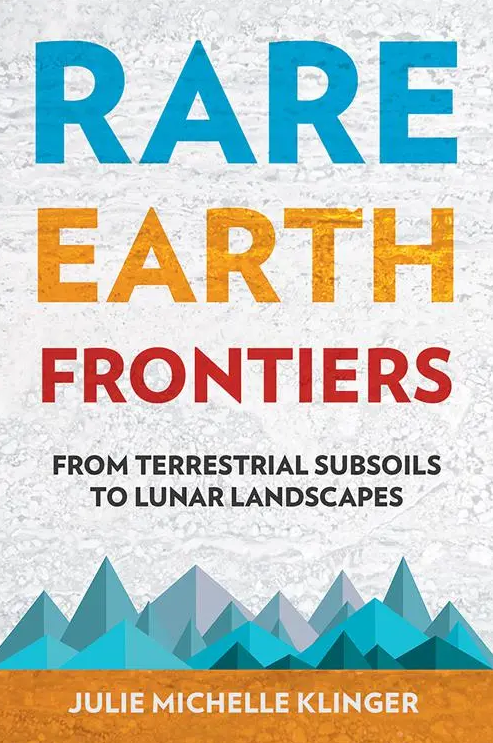
‘Rare Earth Frontiers’ by Julie Michelle Klinger is published by Cornell University Press.
Rare Earth Frontiers is a work of human geography that serves to demystify the powerful elements that make possible the miniaturization of electronics, green energy and medical technologies, and essential telecommunications and defense systems. Julie Michelle Klinger draws attention to the fact that the rare earths we rely on most are as common as copper or lead, and this means the implications of their extraction are global. Klinger excavates the rich historical origins and ongoing ramifications of the quest to mine rare earths in ever more impossible places.
Klinger writes about the devastating damage to lives and the environment caused by the exploitation of rare earths. She demonstrates in human terms how scarcity myths have been conscripted into diverse geopolitical campaigns that use rare earth mining as a pretext to capture spaces that have historically fallen beyond the grasp of centralized power. These include legally and logistically forbidding locations in the Amazon, Greenland, and Afghanistan, and on the Moon. Drawing on ethnographic, archival, and interview data gathered in local languages and offering possible solutions to the problems it documents, this book examines the production of the rare earth frontier as a place, a concept, and a zone of conestation, sacrifice, and transformation.