

.
When I got up this morning, I thought I knew what I was going to write about today. So naïve. Let me tell you a story about home lighting.
.
When we moved to our present house, almost four years ago according to the diary, though that seems unlikely(!), we were faced with the inevitable dilemma; whenever anyone with designerly intent moves into someone else’s house (let’s call them ‘the landlords’) there WILL be a point of knuckle-gnawing anguish, and it often comes in the shape of a light fixture. And so it came to pass that home lighting became an issue.
There are a pair of wall fixtures in the living room that we haven’t used since we moved in because they are so tediously, and predictably, inappropriate. Mind you, its possible to define the entire house in those terms – built a little over twenty years ago – as being tediously and predictably inappropriate to the century that we’re now living in. But neither of us fancied living under a bridge, so here we came and here we are.
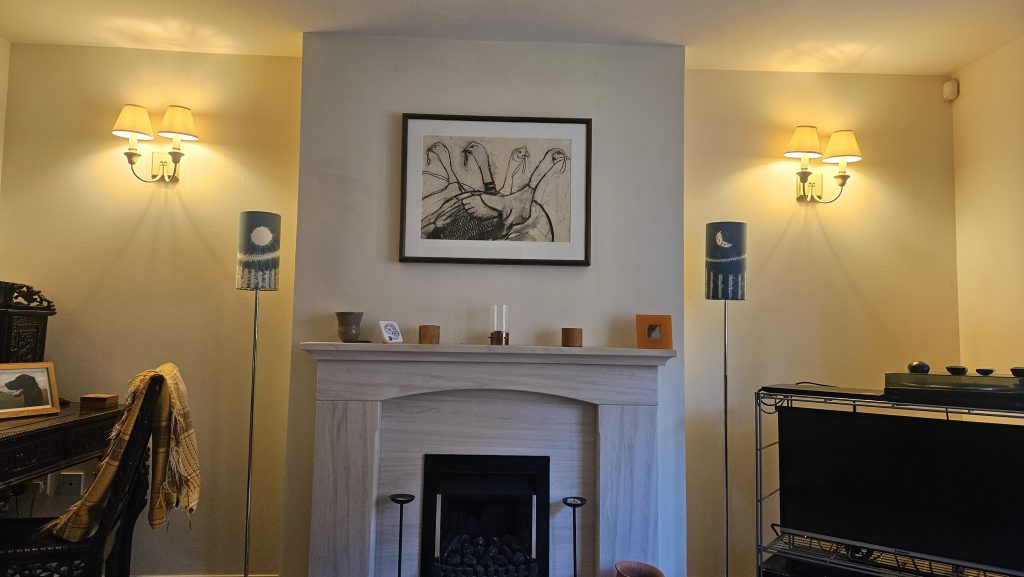
Let’s be brave and look a little closer:
Just to annoy him over the Xmas holidays, I thought I’d ask my good friend and colleague, Chris Fordham (and Design Editor of this organ, of course) to comment. This is what he said.
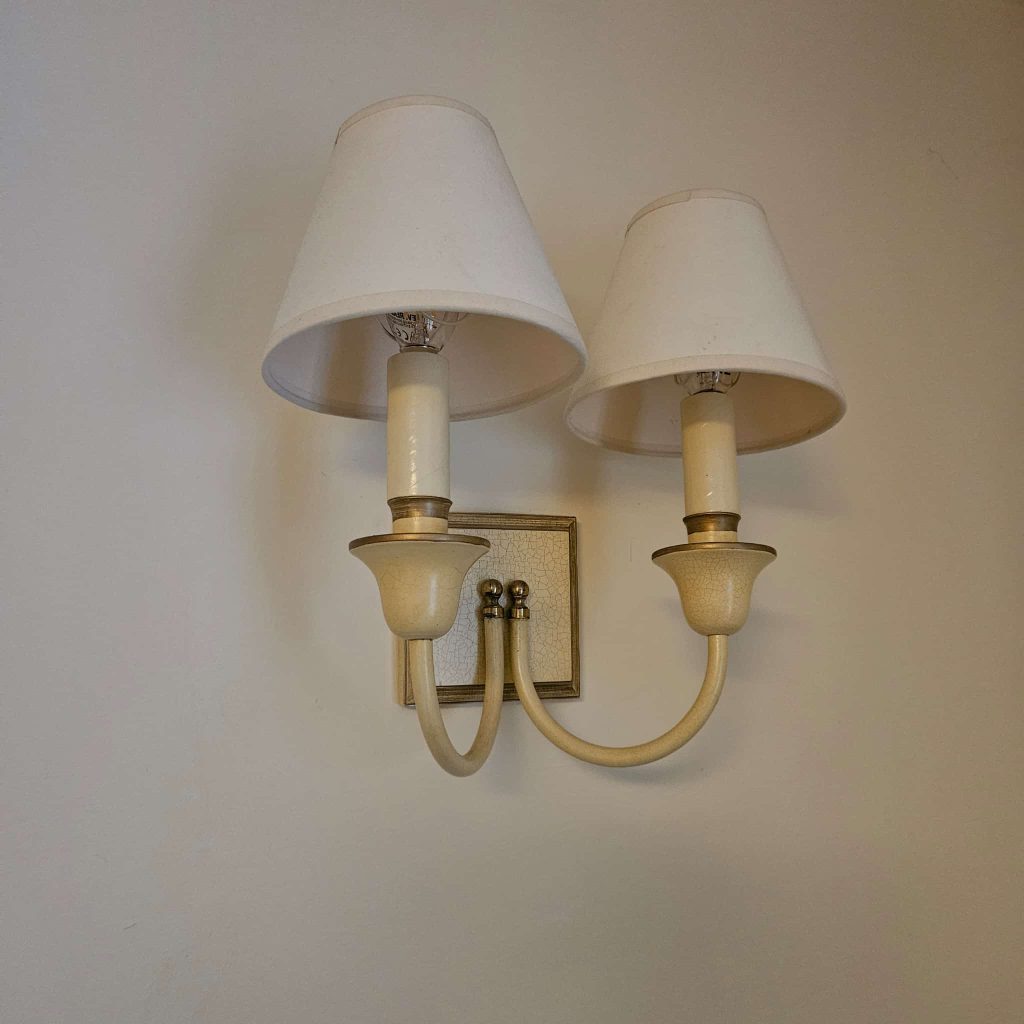
So, what is this before me? Don’t tell me the bastion of good lighting design has … THIS as his front room ?! I mean I know John sometimes has the air of a Victorian school teacher, where these lights would be perfectly at home, but we are on the verge of 2026 and in a modern house, huzzah for the modern-day electrician’s and landlords’ specifications!
The double arm wall sconce is historically significant and probably best suited for stately homes or historic buildings, designed to mimic a traditional style that evolved from the sort of ancient wall-mounted candles we would find in castles, so that feeling of familiarity is probably something we all feel when we see them, especially after a Christmas of watching period films over Christmas like Gladiator, A Christmas Carol, Rise of the Viking and all that jazz.
.
A Victorian school teacher queries: ‘Rise of the Viking?!? What; like Noggin the Nog?
.
So where did this concept start? You can look to antiquity when torches were fixed to walls in Egypt, Greece, Rome to light passageways and grand halls, transitioning into wrought iron and brass holders for candles in the Medieval and Renaissance period. During the 17th and 18th century incremental changes were made such as reflecting backplates made of silver or mirrors, until we arrive to the late 19th century, where ‘sumptuous decoration’ became a thing, with fixtures being redesigned to reflect that aesthetic, often mimicking candles.
.
A Victorian school teacher responds further: For a minute there I thought we were going to get an exposition on the role of the inverted gas mantle. I think Chris is gently telling me (not that I had anything to do with selecting the damned things, I just pay the rent here!) that these things have no place in our modern world.
And I agree with him. Moving on . . .
.
Zombie Lighting
I needed a name; what to call a thing that has had its time, has no right to still be in this world and yet won’t go away. In other circumstances we might call that presence a ZOMBIE, and that’s good enough for me.
Should I ever bother to think about such things then the itch that I would need to scratch is this: who feeds the zombie. I don’t mean with actual physical nourishment – they’re meant to be dead when all’s said – but where does the Energy come from that maintains their presence and keeps them upright.
Answer me that and stay trendy!
Let me try a little trendiness (apologies to Otis Redding!): if folk in general stop thinking about a thing; stop obsessing about stuff and don’t indulge in noxious nostalgia, then some things will disappear. On the other hand, if no one can see beyond the inside of a ‘stately’ home we mustn’t be surprised if some of that yearning continues to infest our group consciousness – and often in the form of wall lighting tat that has no place to be haunting our subconsciousness, lurking in the canyons of our minds.
Finding a practical solution
Let me remind you; these fixtures do not belong to us; its the simple fact that our tenancy agreement requires us to look after them. So, yes, there are a pair of zombies in our living room.
There’s an image that’s been in my head these past twenty five years. Now, I’m no great fan of Phillipe Starck (I’ve suffered the indignity of working out how to use the gents in Café Costes, in Paris, and have never forgiven him for it. As my mother would have said to me if she’d ever thought of it; “don’t forget, my son – never piss on a light fitting.”)
No, it was the stunning job that Starck made of the Sanderson Hotel in London that’s stuck with me; the way that he used sheer fabric wall hangings to veil the walls, with its artworks . . . AND WALL LIGHTS. That took my breath away at the time. Is it still there; I have no idea. I live too far away. But next time you’re in Berners Street W1, call in and have look. Let me know.
Or maybe just search for Sanderson Hotel images and you’ll see what I’m talking about.
Move the eye away from the physical and what you left with is a ghosted image. We enter a kind of Miss Haversham world, without the dust and the rats. Would it be possible, I wondered, to take best care of these zombie lights by covering them up . . . almost. And then switching them on.
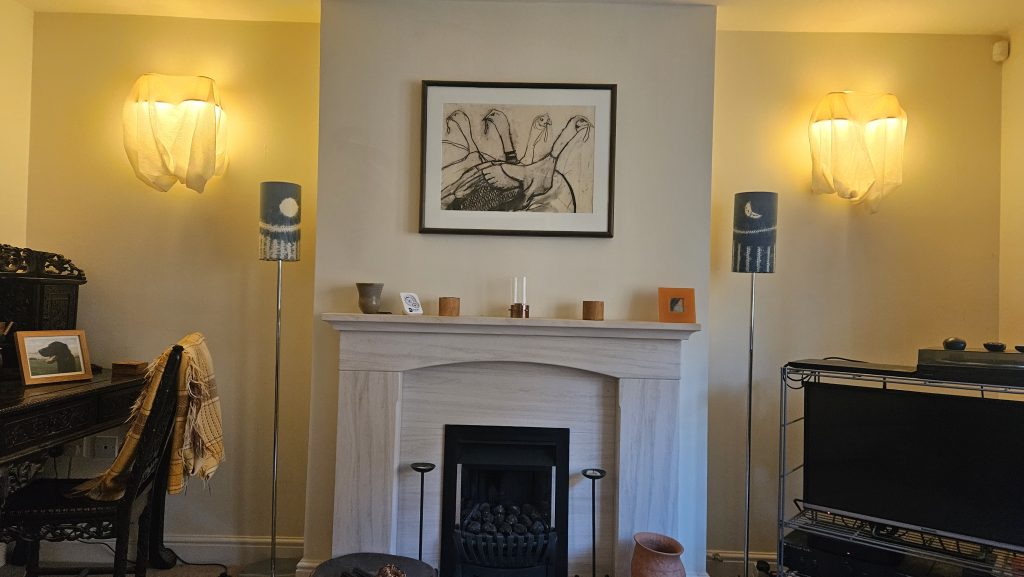
And so my idea of THE GHOST LIGHT is born.
From Zombie to Ghost – how uncanny might that be!
.
Living with a textile designer really helps with this kind of project. It means that the heavy thinking gets done by me and the heavy stitching gets done by Annabel – who knows how to do it. So here we are, finally hip to the jive – as I believe the young people say.
Don’t try this with tungsten filament lamps, children.
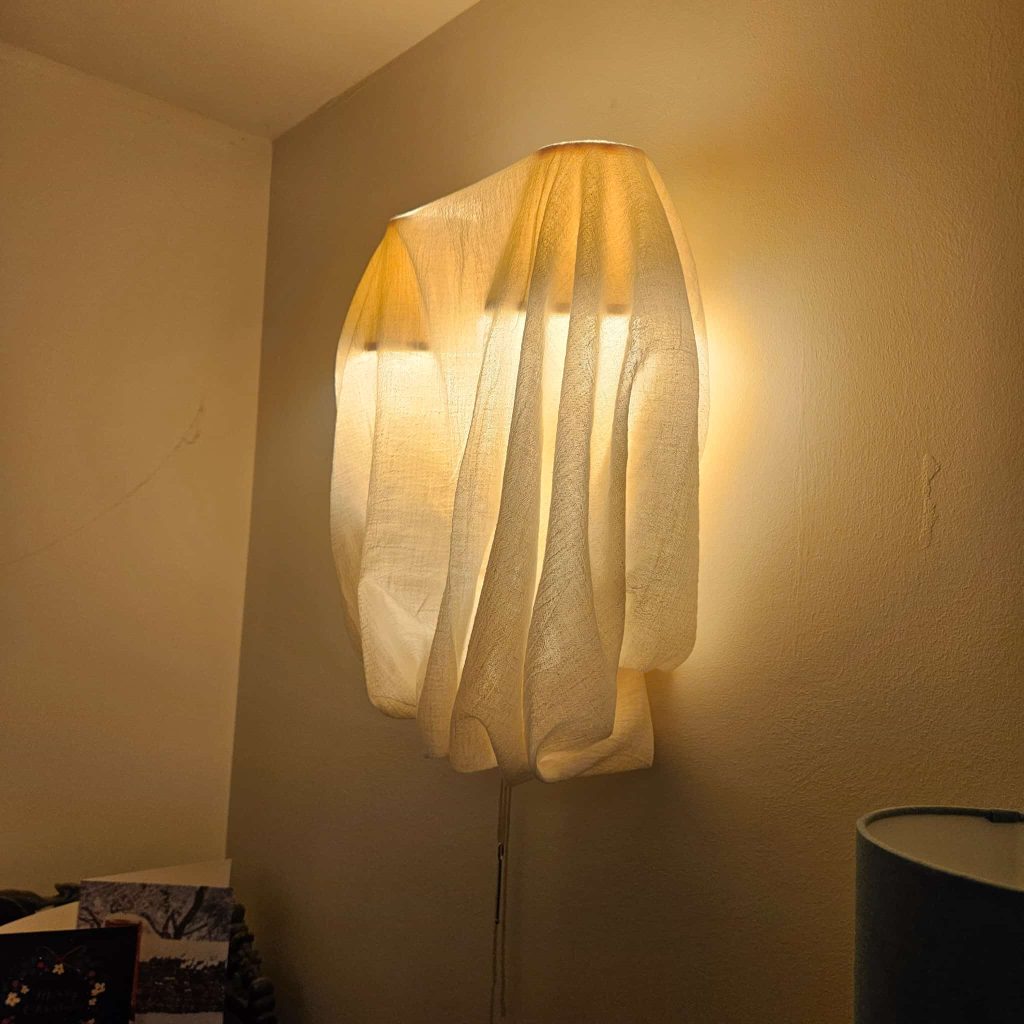

And a shout-out for the textile designer with the needle and thread: the pair of floor-stand fixtures are what we’ve been using for the past four years. The shades are in a hand-crafted shibori design from Townhill Studio. There, a plug for my partner. At last!
.
.