

We don’t hear a lot about Cradle-to-Cradle design in the lighting industry; but it is happening. Waldmann has recently introduced Lavigo, the first office luminaire to gain Cradle-to-Cradle certification. Jim Ashley-Down, MD of Waldmann Lighting in the UK was invited to join a panel at the Edinburgh Science Festival. We asked Jim to let us know how he got on.
Dangers of Obsoletion: 12 April, 2019
Chair: Matt Wright, Director of Pianodrome Community Interest Company.
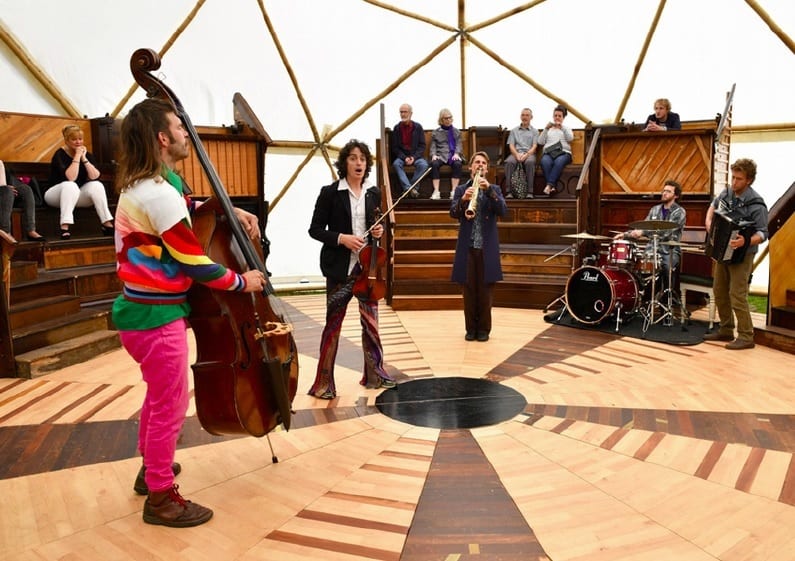
“To give you all an introduction I used to work with the Science Festival as an event developer – I am currently producer of the Pianodrome – the world’s first amphitheatre constructed entirely from disused pianos.. Pianodrome is an upcycling solution to a waste problem, but also a re-thinking of our relationship with waste in contemporary society. Pianos have not so much become obsolete as less convenient in a fast-paced, down-scaling society. But they also just get old and defunct. I wonder how pianos might have been designed with a cradle-to-cradle philosophy in mind?”
Panel/Presenters:
Paul Capel, Co-founder and Director of Cradle-To-Cradle Marketplace
Ross Cowie, Officer of the Producer Compliance and Waste Shipment Unit at Scottish Environmental Protection Agency, (SEPA)
Jim Ashley-Down, Managing Director of Waldmann Lighting Ltd.
Jim Ashley-Down writes:
Waldmann’s philosophy is to be as sustainable as possible, to have the best possible outcomes for users and the environment alike through our processes and products. To further strengthen this aim the Waldmann family decided to support the Circular Economy through certifying products to Cradle-To-Cradle standards. The intention to demonstrate our responsibilities in a recognisable way, and to set an example to other manufacturers in the lighting industry.
Cradle-To-Cradle is a worldwide certification concept based on the reduction of waste, where possible to zero, and thus minimise the impact of products on the environment.
More information on Cradle-to-Cradle design can be found at EPEA-Hamburgand on the Waldmann website.
Through this initiative Waldmann gained the world’s first Cradle-To-Cradle certification of an office luminaire; going forward all newly developed office luminaires will also be put through the certification process. A few months ago I was introduced to Paul Capel, who with Brendon Rowen co-founded the Cradle-To-Cradle Marketplace and Cradle-To-Cradle Design; initiatives to enable consumers to source Cradle-To-Cradle products (C2C Marketplace) and for companies to use a consultancy service to specify, build, and manage their business more sustainably (C2C Design).
Paul, as keynote speaker for the “Danger of Obsoletion” event at the Edinburgh Science Festival, suggested to the organisers it would be a good idea to get perspective from the other side of the Cradle-To-Cradle story, the experiences of a manufacturer that has gone through the certification process, hence I was invited by the Festival to participate in the event. With an 8pm start time on a Friday night some of us had reservations as to how many people would attend (also, this was a paid ticket event) but the room was at 75% capacity, and had a very diverse spread of attendees.
Looking out over the audience it was immediately obvious the circular economy is something of concern to almost everybody. The age spread was, I would estimate, from early 20’s to 70’s; there were several ethnic groups present and, we would later find out, an interesting breadth of economic prosperity. This was a public event. The audience were people from all walks of life who do not, necessarily, have any professional involvement in the Circular Economy, just a conscience to do the right thing.
Matt Wright opened the event with a presentation on his project, the Pianodrome. Taking 50 end-of-life upright pianos he, and a group of volunteers, created a 100-seat amphitheatre-style performance space which was used during the Edinburgh Fringe Festival in 2018 as a music and spoken word auditorium. The end result is surprisingly beautiful and works well for its intended use as a venue.
Ross Cowie’s presentation on the SEPA and regulatory side of things opened a lot of eyes in the audience. In general, it would seem very few people who do not have direct involvement in things like WEEE have even heard of it. Ross explained what WEEE is, then used a theoretical case study of a waste fridge, and what happens to it once it enters the recycling process chain, Of the 33,000 tonnes of processed WEEE in Scotland in 2018, 9200 tonnes of that was “cooling appliances” such as fridges. This averages at 630 units per day!
Ross also made a surprising point; SEPA do not have any regulatory control over the systems or processes. Of note is the fact that the 33,000 tonnes of processed WEEE is only a fraction of what was scrapped through other means. He pointed out that while there are many regulations in place there is very little enforcement possibility, the net result being that many products which should and could be recycled are simply ending up as useless waste.
The concept of Cradle-To-Cradle was introduced to the audience by Paul Capel. Through the course of his presentation it became quite clear that this is an obvious way to design better products, to guarantee their future component potentials, so long as the product is correctly returned and recycled at the end of life. This seems to be one of the limiting factors of the “technical” cycle in Cradle-To-Cradle. Ultimately, the product needs to be dealt with responsibly at the end of it’s life. Through initiatives like Cradle-To-Cradle Marketplace Paul is hoping the circular economy can become easier, and more understandable for people to become part of.
After Paul it was my turn to talk about the challenges for a manufacturer to certify a product to Cradle-To-Cradle standards. Our Lavigo, an existing product, took two years from the start of the process to certification, and only minimal changes were needed to its composition (mainly the cables). While some of this long duration was spent looking at the company aspect of the certification (not just the product) this is a very long time in development terms. I suggested this could be a major reason why there is not more uptake in manufacturers attempting to do Cradle-To-Cradle on technical products. It is entirely possible that products will be functionally and technically obsolete before they are even released if this time scale remains the norm. The process has got to be quicker if there is to be a wider uptake.
It was surprising to Waldmann, and also to the audience, that Cradle-To-Cradle includes criteria for “social fairness”. This is often overlooked as an aspect of business in general, yet it is very important to society. Including it in Cradle-To-Cradle certification is a great thing to do but could be another restricting factor in some products not becoming certified because their manufacturers don’t meet social requirements. It’s not to say they are “bad” manufacturers necessarily … the social fairness criteria looks at more than just treating your workers and suppliers fairly. Active initiatives are required too.
Waste collection
This leads me onto the first question we were asked during the panel discussion. The topic of social fairness struck a chord with one particular member of the audience who introduced himself as someone living on the poverty line, in receipt of benefits and living in social housing. He explained that every penny he has goes towards his day-to-day living expenses. There is nothing left for “disposable” income. Having seen the Lumicom recycling video I showed at the end of my presentation he asked why similar systems were not offered to the consumer. Lumicom collects old luminaires from a commercial job site for free; the payment has been made in advance by the manufacturer of the new luminaires through their registration with Lumicom. When this audience member recently bought a new (second-hand) fridge because his old one had broken he asked the council to collect the old one for recycling/processing. The council wanted £25 to collect it. Had he been able to take the fridge to the local recycling depot himself it would have been free to leave it there. However, he has no car, or access to other suitable transport. How, he asked, is someone in his position meant to do the “right thing” when he simply doesn’t have the space cash to do so?
A wider discussion arose around this – why isn’t the manufacturer responsible for these costs? The actual situation, generally unknown to the public is that, as Ross and myself pointed out, the manufacturer IS responsible for these costs, and does (hopefully) pay the relevant authorities to cover things like waste collection (for example Waldmann pays Lumicom). It seems that those funds are not, ultimately, making it through to the people who need it. There needs to be a way around this in the consumer market.
Social Fairness? Apparently not in the consumer white goods market!
Later on, in the bar, some of us had quite a heated discussion on who’s responsibility this actually is. One person’s viewpoint is that it should be the manufacturer who collects, “it’s not the council’s responsibility, they have enough to do with their funds”. Her argument was that the council didn’t create the problem of the unwanted fridge, they didn’t manufacturer it or break it.
However, if you look at the other side, if every manufacturer had trucks driving all over the country picking up unwanted goods what would that do to congestion and air quality, and cost? Ultimately all those goods will end up in the same recycling facilities. Surely, it’s better to have a smaller number of collectors, collecting on behalf of many manufacturers – domestic collectors along the lines of the commercial ones such as Lumicom, for example.
The system is designed for larger collection quantities from commercial sites, but what about the domestic consumer, especially those in a situation like our low income friend? If it’s not the council’s responsibility to collect unwanted WEEE then why is it their responsibility to collect unwanted landfill waste (your non-recyclable wheelie bin) and unwanted glass, tins, and paper (your recycle box). The council doesn’t sell you tins of beans or Amazon delivery packaging, but they still collect it! The economics of this are clear. The councils are given funds to do this, through council tax, Government funding, and so on. The WEEE payments made by manufacturers must go SOMEWHERE? So where are they going? Are the councils getting them? None of us really had a clear answer on this, unfortunately. If products can be collected in the commercial world (at least for lighting), why not in the consumer world?
Product repair
Another audience member asked a question centred on the “right to repair”. How can manufacturers justify making products that are not repairable? There is no easy answer to this, it depends on the product, but it’s the right question to ask. A washing machine, conceivably, is repairable. It’s not so easy with a product that, by it’s nature, needs to be “sealed for life” or to have components bonded together for operational reasons. Cradle-To-Cradle takes repairability and upgradability into account, but ultimately there will always be some products which are un-repairable.
Product warranties
Someone else remarked that most manufacturers invalidate their warranties if their products are repaired by someone other than an authorised source, even if that authorised source is reputable and did a good job. This caused a reaction. If your local repairer can do a good job reliably and quickly, why send the product away to get the same thing done, and be without it for weeks?
In-built obsolescence
Another audience member picked up on the repairable problem from a different angle and described how he once bought a Pentax compact camera. After a couple of years the rechargeable battery stopped holding a charge. He tried to buy a new one, but they had been discontinued and there was no aftermarket alternative available. The entire camera became junk because of a defunct battery. Why, he asked, is there not more standardisation of things like batteries? He didn’t want a new camera, but it had designed in obsolescence!
And so to the bar . . .
The audience were so keen to keep asking questions the venue eventually had to throw us out of the room, and suggested we move proceedings to the bar. They didn’t need to ask us twice!
In conclusion, this really enlightened me as much as it did the audience. Operating in the sheltered world of lighting and thinking about these things from a purely commercial B2B aspect I had not, previously, considered the consumer side of the market other than through the two wheelie bins outside my house and my local recycling centre. It would certainly seem, from our audience’s reaction, especially their reaction to the description of the successful model of Lumicom, that the consumer market needs a lot more effort put into it by the regulators, the manufacturers and, yes, the councils, to ensure end-of-life products are processed in the best way possible; easily, and with no end-of-life charges to the consumer.
The final word, from our friend with fridge problems, “If I am already expected to pay a bit more for my new fridge with these WEEE charges that the manufacturer has to pay, why do I have to pay again when I want to get rid of it properly? It just means I ask some fly-by-night with a pick-up to take it away for scrap”.
Fly-by-night . . . Fly-tipping indeed – because that fridge had to end up somewhere.
