

I’m in Bristol for an annual conference. This by The Green Register and the headline topic is ‘from Linear to Circular – a whole mindset’.
.

(image courtesy of Recolight)
The Green Register has been providing training for construction professionals from all disciplines of the sector to build better, more sustainable, buildings. Over the years I’ve worked with The Green Register, presenting sessions on the development of the LED and how light energy has improved as a consequence, to presenting one of the GR Twilight webinars earlier this year along with Nigel Harvey of Recolight, talking about, of all things – the circular economy. We called that one ‘Reducing the environment impact in light fixtures – whole life costing and life cycle analysis of lighting’. And that gave us plenty to talk about.
The GR annual conference wasn’t a lighting event, and I was there to share the platform with Richard Halsay of Energy Systems Catapult to talk about ‘Products as a Service’. Richard talked about heating system design and management and that left me to talk about how we’re engaging with the circular economy in the lighting industry – and how future models of Light as a Service might work for us.
The audience was made up overwhelmingly of sustainably-minded architects, the majority of whom reckon that they ‘care about’ the lighting in their designs, but with only a small minority having any responsibility for the lighting specification; so perhaps that’s where we need to put some energy. By any description of Light as a Service we must have client buy-in, and that means architect buy-in also. We can’t afford to leave this to the D&B sector – their interests lie elsewhere.
If we think that we’re ploughing a lonely furrow in the construction sector, the conference showed to what glorious extent the architectural profession is stepping up to the wicket in circular design. We saw examples of buildings that were designed as a kit of pars that can be assembled – disassembled – reassembled without wasting a single component; including a building that was moved from one site to another as part of that company’s expansion plans.
And these are not ‘pre-fabs’. This is serious building design, incorporating all of the elements that you might expect to see in a ‘conventional’ building.
.
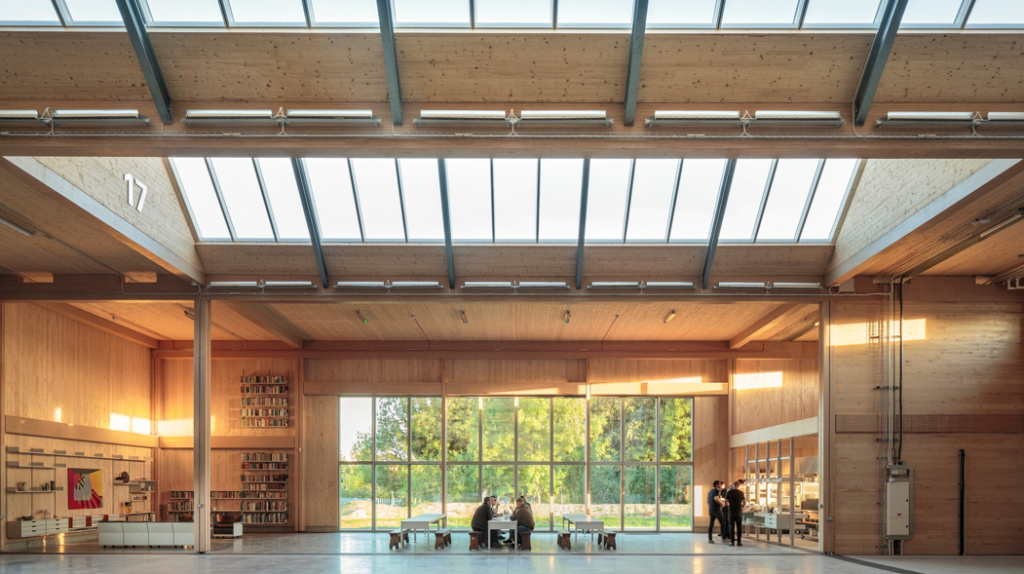
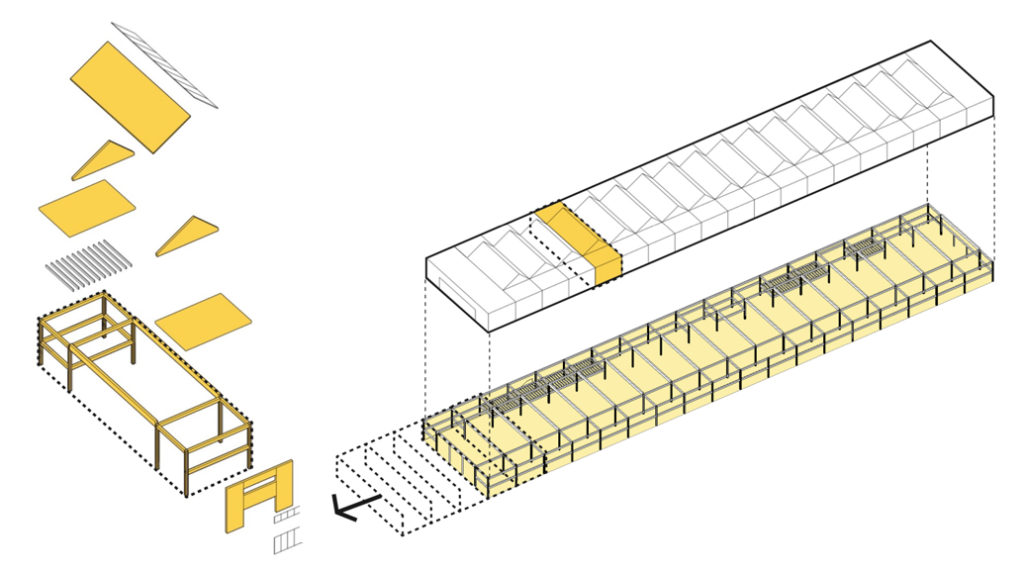
.
One thing that I will say, though, is that we do need to talk to these guys about the state of their lighting. These buildings are deliberately ‘lightweight’ so you don’t see too much opportunity to integrate lighting into the fabric; lighting is applied – and its not so discreet. It may be that, with daylight so evident in the structural design, that artificial lighting isn’t at the forefront of the designers. As I write this in the depths of December all I can say is – that’s not necessarily a clever route to take.
.
.
While I’m here, and nothing to do with lighting, but here’s a video that Energy Systems Catapult is involved in:
.
Warm Home Prescription – Helping people with cold-related health conditions and low incomes
.
.
.