

.
I first started writing about Sustainability in Lighting (CSR in Lighting to be more accurate) back in 2012. It was like shouting down an empty well. The first opportunity I had to address a conference audience, a friendly voice from the back of the room said; ‘Why should we care, John? You’re the only one talking about its stuff.’
That’s a question that’s stuck with me and, I also realise, influences my reading and understanding of a lot of other ‘single issue’ campaigns. I know – I know – Dark Skies is no more a ‘single issue’ than Sustainability is about energy usage, but I hope you see what I’m getting at.
I came to Dani Robertson’s cri de coeur with that same old lens stuck in my eye: Why do I care? Should I care? Go on – convince me.
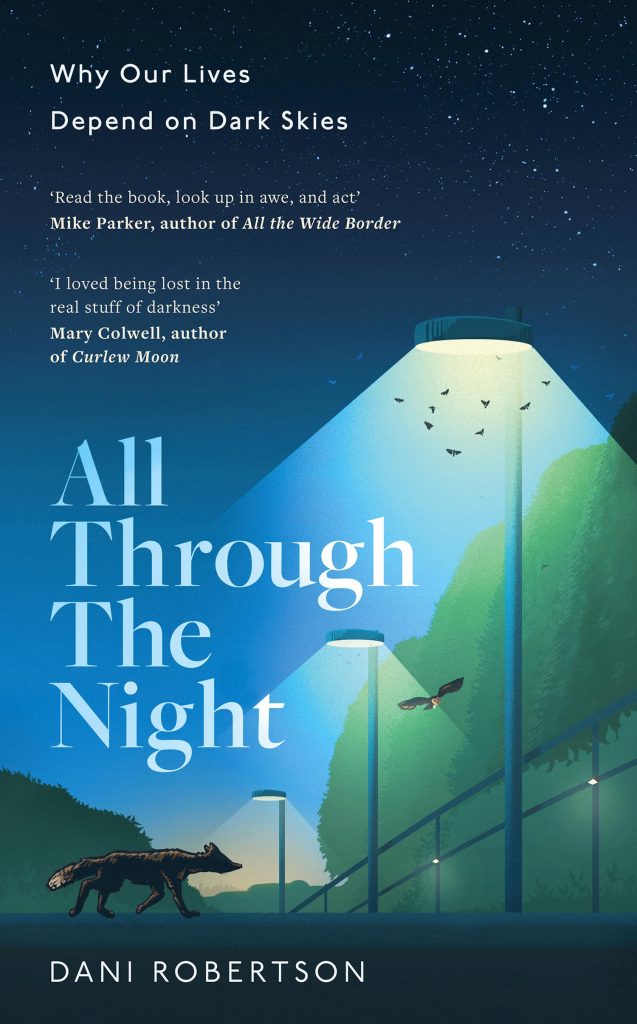
The csubtitle on the cover says: ‘Why Our Lives Depend on Dark Skies.’
The opening sentence of the Author’s Note says: ‘What if I told you I know of the ways to save the world?’
I mean – how many targets does a cynical old man need so as NOT to need an excuse not to reada book? And having said that – YES I thoroughly enjoyed reading the book, once I’d got the hyperbole out of the way and realised what is was that Dani Robertson is trying to tell us.
My first misinterpretation was that this was going to be a journey through the Dark Skies design manual, explaining the practical ways that we can best serve the darkening of our night-time skies. After all, we’ve all read the ILP Guidance Notes and the SLL documents; we’ve all been part of the audience for Dark Skies presentations and I’ve hosted Dark Skies podcasts that you may have seen. The ‘experts’ are well-represented in this light-polluted field.
But what I wasn’t expecting was heartfelt enthusiasm for the subject; not just a technical and barely-aesthetic review on how to do things better.
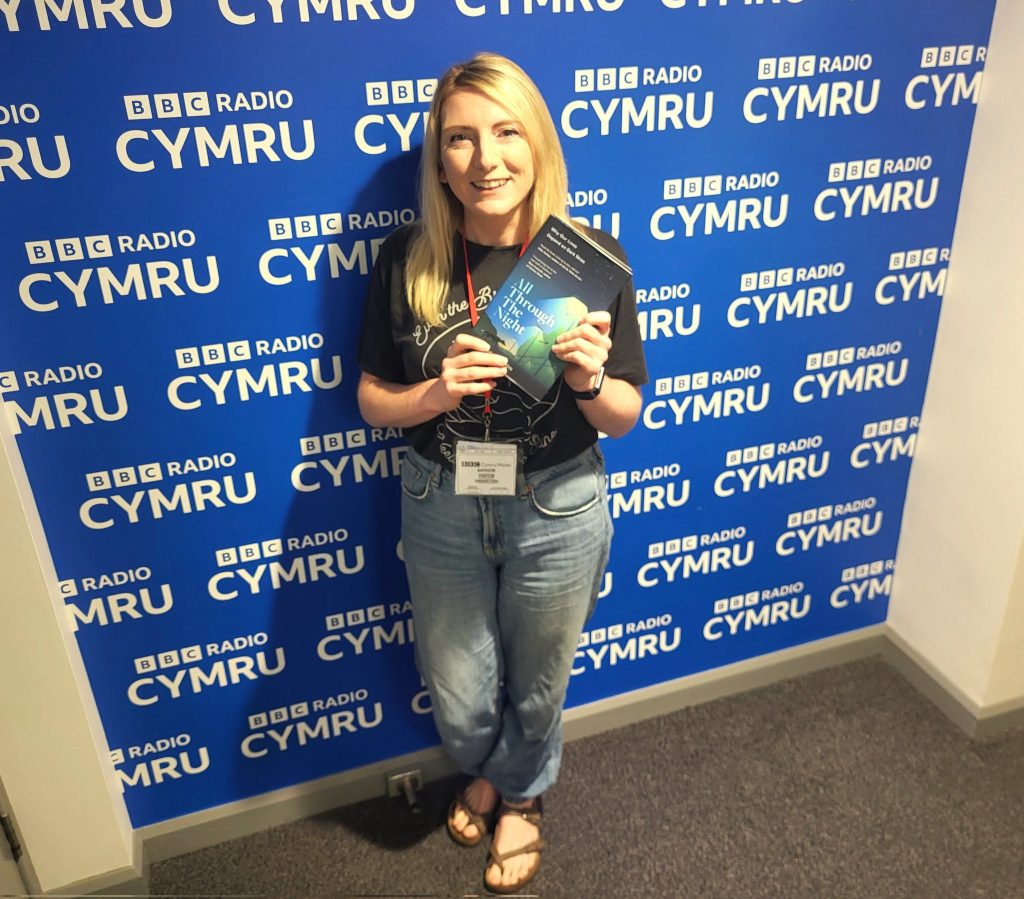
Dani Robertson is a Dark Skies advocate and she also has skin in the game, courtesy of her day job as Dark Sky Officer for Eryri (Snowdonia) National Park. In her book she explains to us WHY this is such an important matter – demolishing my key trip hazards of the whys and should in the process.
Light pollution closes the curtains on the infinitely larger part of our existence. Small planet, small mind; very big universe, limitless imagination. (Blake’s ‘doors of perception’ if you like)
Referencing one of those other not-really-a-single-issue issues, most people know that I’m working with Dr. Shelley James on circadian lighting and the importance of Near Infra-Red to human health. One of the important voices in that discussion is Bob Fosbury. Bob is an astronomer with a very big spectrometer capable of measuring the entire spectral output of a star. It’s the kind of thing that makes you look skywards a lot more, because Bob forces us to consider what’s actually going on with sunlight (starlight) and what those wavelengths do when they get inside the body (very good things, usually!). As Bob says, without sunlight, we’re not here. Let’s extend that a smidgeon and say that without starlight we’re not here.
So – I muse – what if we metaphorically look over our Sun’s shoulder and go deeper into the ‘void’. The starlight that I can see is personal to me and me alone; those are MY photons travelling through the cosmos, meant for my eyes only. My neighbour, standing next to me, gets their own photon delivery; there’s plenty to go round, from thousands of stars, thousands of light years away. And when those photons enter my eye, what then? I’m assimilating photons that have travelled all that way . . . just for them to say hello?
Whatever they are trying to tell me, light pollution makes such a visual noise that I can’t make out those messages from so very long ago. Thus, I remain trapped in my small mind, on my tiny world.
Whoa – I’ll be getting my old caftan and cowbell out if this goes on much longer!
Here’s the thing:
Dani Robertson loves the night-time sky – as should we all. In her book she takes us on a journey into the history of humankind’s belief systems; into the psychology of darkness – and why we fear it so much; lifts the fetid lid on how governments (and billionaires) are monetising and militarising near space – and she also finds space in the final chapter to look at Dark Sky initiatives, coming from such heroes as Andrew Bissell and Kerem Asfuroglu.
Oh – and not quite as an aside, Dani seems to be of the opinion that street lighting design is gender-biased, and I agree with here. We have had men designing for ‘us’ for far too long, without even asking the questions of what the other 50% of the planet might want. That’s possibly not deliberate; after all, men have known what’s good for women for a long, long, long, time.
I’ll quote Dani on this one: ‘Women deserve access to the night. It is time to demand safer, Dark Sky friendly, street lighting, to light the path to an accessible night for all.’ Hurrah to that.
As you’d hope and expect, All Through The Night finishes with some basic Dark Sky Friendly rules:
- Use fully-shielded and cut-off lights that are downward facing only;
- Use energy-efficient bulbs that are the lowest level of brightness needed for the task;
- Use timers and motion sensors, never desk till dawn sensors;
- Use lights with a warm colour temperature, 3000K or below;
- Use backout blinds and draw them after dark;
- If its not useful, switch it off.
And if all you ever do with this book is to read these six rules . . .you’ll have missed a great journey across the night-time sky.
All Through The Night is either a paean or an elegy for Dark Skies – its for us to choose.
.
.
The technical bit:
All Through The Night
Pub: Harper North (www.harpercollins.co.uk/green)
HB ISBN: 978-0-00-858672-0
.
.