

.
On my way up to town for the 2024 edition of Circular Lighting Live I was trying to remember when Recolight inaugurated this conference series. Was it before Covid, which would probably put it in 2019, or was it meant for 2020 and, like so much that year, held back until more healthy times?
What do you mean it was in 2022?
That can’t be right, can it?
.
Well – it is and it isn’t. For sure, the first proper Circular Lighting Conference was at the Cavendish Conference Centre in 2022 but the idea of a Circular Economy conference had been going for a bit longer than that. According to the historical record (my dodgy diaries and even dodgier memory), the first outing to talk about the Circular Economy was back in the autumn of 2020 – dodging the lock-downs – held at The Crystal in London’s Docklands.
Even so, we’re still talking about only five years to get from an idea that most people hadn’t considered in that era of take-make-waste to a procession of manufacturers explain how they have embraced the circular principle – and the commercial benefits that have come along with it.
.

.
Back to this year’s edition of the Circular Lighting Live conference:
There is a definite shift in the conference programme, with a greater – and more confident, – emphasis being placed on what’s required of the manufacturing (and specifying) community, compared with the evangelical presentations of previous years. We’re now hearing – and talking – about the hard yards that everyone needs to put in, given that the construction industry is taking this very seriously indeed and our industry has had to respond accordingly.
‘In-house’ assessment methods such as TM65 and TM66 are incredibly useful tools to have. All of the work that was put in to make those platforms accessible to companies (and specifiers) of all sizes has paid off – but its also clear that the audience for these self-certified statements is hungry for more and better. The construction industry will determine the quality of assessment here, and marking your own homework simply won’t cut it.
Birger Holo group technical director Glamox was the first to make the point:
‘It is all about data – amount and quality’
.
and backed up by the company’s three ‘guiding stars’ of
- Transparency
- Traceability
- Credibility
If you were listening for the day’s mood music, that was it. The words may have been different between presenters, but the meaning was exactly the same; for companies to be taken seriously they MUST engage in third-party independent assessment of their operations.
We all know that this journey is a long one (I usually put in a mention of climbing Mount Sustainability, an idea put into everyone’s heads by Ray Anderson, founder of Interface)
(Confessions of a Radical Industrialist: pub. Random House Business Books. 2009).
Later in the day, we heard from Michael Collett, from Auditel, of the Importance of Scope 3 in the GHG Protocol – and it deserves its capitalisation because of what it means for everyone. In environmental terms:
The Greenhouse Gas Protocol (GHG Protocol) classifies a company’s carbon emissions into three scopes, based on where the emissions originate from:
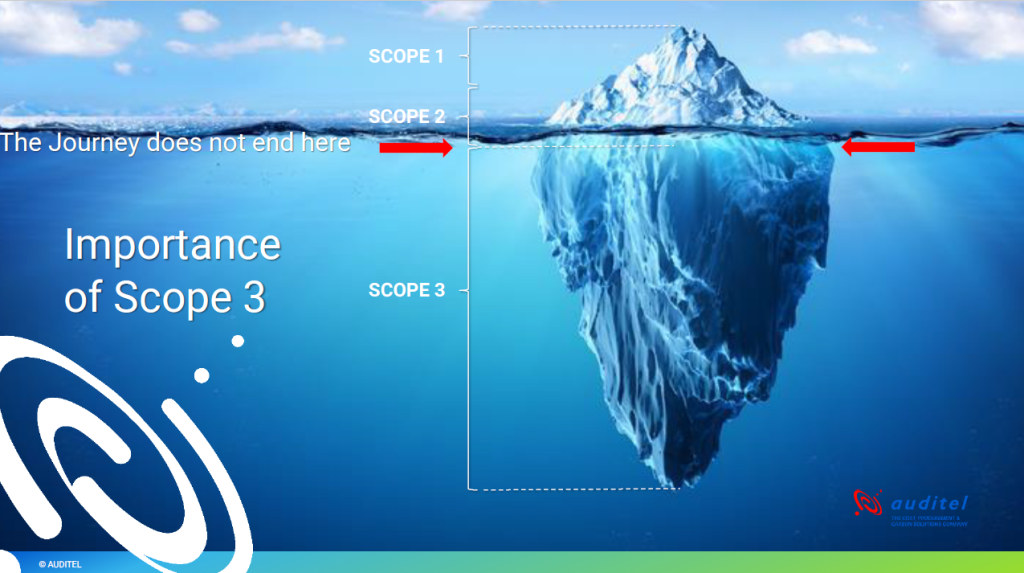
Scope 1 refers to initiatives that are within the control of the company itself; the buildings and the transport fleets, for example.
Scope 2 moves beyond the company walls to look at the energy feed-in to the business and where the energy that supports the business comes from
But Scope 3 . . . oh, Scope 3 . . .
Scope 3 looks beyond the company outputs to embrace both upstream and downstream activities, and that list is a long one, because it includes every other business that services the company itself.
.
What we are all hoping for is that those companies that service our own businesses are going through the same process so, like a well-fitting jigsaw puzzle, the pieces simply slot together. That’s why commonality of data is so important.
And I can’t finish this review without a comment about the role of the lighting designer/specifier. Somewhere along the process, the lighting specification needs a shepherd to keep everything under control and to deliver the desired specification into the project (where all the other shepherds will have been doing the same for their own sectors).
Kael Gillam of Hoare Lea took on the burden of explain just what all of this means for the specifier. The days of just wanting to do good lighting designer are over; our industry needs to develop a bit of muscle and acknowledge the responsibility that a lighting design entails.
As well as (not instead of . . .!!) producing excellent aesthetic design, here are some of the things that we’ll be obliged to enjoy as we move forward:
- Life Cycle Analysis
- Environmental Product Declarations (EPDs)
- TM65.2
- TM66
All of the hard work is really on the backs of the manufacturers; after all, it risks ending up as ‘no data, no specification’. But I believe that, as a specifier, it’s also my responsibility to assist manufacturers in their environmental journey. There will be a thought of going to the ‘best-presented’ data sets – but that doesn’t guarantee the best product. Sometimes, climbing the foothills of Mount Sustainability gets a bit tough -but the view from further up is staggeringly beautiful
.
And while we’re thinking about all of this . . .latest news from Recolight!

Recolight has announced the first date for a new LCA and EPD training workshop. The one day, in-person session will run on 27 November in London. It will provide hands on guidance for lighting manufacturers on Life Cycle Assessments and Environmental Product Declarations.
The workshops will feature a roundtable environment with a maximum of 12 delegates, giving the opportunity for full interaction, feedback, and questions for each topic.
They are intended to equip participants with the knowledge and tools needed to understand LCAs and EPDs for lighting products, the timescales, data requirements, and how best to use product families to minimise costs. The importance of product specific rules, and the role of the luminaire specific PSR-0014 will be covered in detail. There will be opportunities to see online LCA preparation in action, and will include case studies of luminaire LCA data, and use of a luminaire specific EPD creation tool.
Lighting designers, specifiers and end users are increasingly demanding credible third party certified environmental metrics. LCAs and EPDs are widely seen as the best way of meeting those needs. With an increasing number of lighting producers announcing that they have made LCAs and EPDs available, those that don’t act, risk being left behind.
The workshop will be led by LCA expert and Recolight Environmental Metrics and Training Manager Dr Max Robson. Representatives of One Click LCA will also attend the event and will be able to answer questions regarding the operation of the automated One Click LCA system and the EPD Hub.
Commenting on the news, Recolight CEO Nigel Harvey said “This workshop is intended to help lighting companies quickly get up to speed with LCAs and EPDs – to understand how to get started, what data they need to collect, and how to simplify and speed up the process.”
For further information and to book a place contact training@Recolight.co.uk
.
.
.
.