

Dr. Shelley James’ new book, published just before Xmas 2023, is the first ‘light’ book that I’ve read that isn’t really about Light. Well – I mean . . . it IS about Light, but whereas most guides to lighting put the light itself front and centre of the action, Shelley writes about Light as a tool that’s put to work to the betterment of the people employing it – and that’s typically you and me . . . and just about everyone else.
.
This is a book about Health.
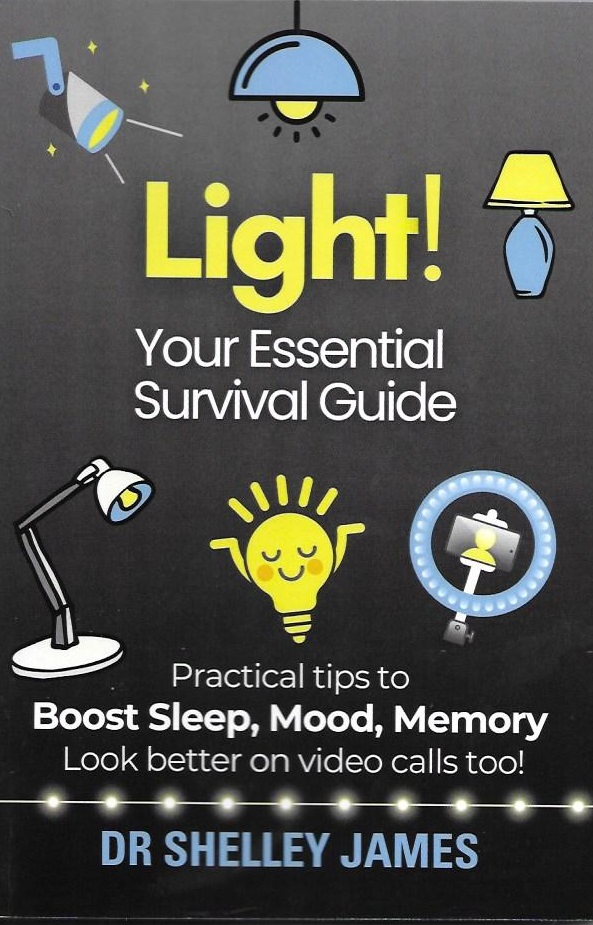
.The book’s subtitle says it all; ‘practical tips to Boost Sleep, Mood, Memory – Look better on video calls, too!” And if we make the not-so-giant-leap to associating a good video image with a general sense of emotional wellbeing, then getting the lighting right around your webcam is a damned fine idea.
‘Light! Your Essential Survival Guide’ is a workbook, as the title suggests. A few of my friends work as wellbeing councillors, looking to improve the daily life of their clients. I know that most of them have already got hold of a copy of the book. That gives us a clue as to the target market. Its not just a personal guide to better living, it’s becoming a component part of broader psychotherapeutic practices.
It means that it’s not a technical source book, though Shelley can’t help her academic approach. The final thirty pages are references to scientific publications. My first recommendation to everyone is NOT to start the book from the back – it’s altogether too scary. Shelley, we trust your knowledge!
The first half of the book covers the important stuff. There are three main headings: Sleep, Mood, Memory. As Shelley puts it:
- How can you get a better night’s sleep and stay positive, especially in winter?
- How can we use light to help us feel happier?
- How can you keep your brain sharp and alert, especially as you get older and deal with stress and hormonal changes (men and women!)
.
Throughout this section of the book Shelley focuses on the individual, whether that’s you, the reader, or those loved ones in our lives who may be looking for help – or perhaps not realising that they need help – to improve their life by improving their mental health. It’s the kind of book that you read, and then act on; and then to your friends and colleagues (don’t forget to put your name in the front of the book or it could be lost forever as it passes from one light explorer to the next.)
The tools that she suggests are generally available, rather than requiring major rewiring or an entirely new building, and the workarounds to get you to a better place than you’re in currently may not always be the ‘ideal’ solution – but they will make lie better. After all, this is one of those areas of life where, if we’re not careful, we end up playing the game of good-better-best and then not bothering because we can’t get beyond just ‘good’.
Don’t let the perfect get in the way of the merely good. We need to make these changes, so let’s crack on, shall we?
If I have quibble, and it is only a quibble, it’s the change in tone in the second half of the book. We move from a gentle self-help book to a gentle and-this-is-how-it-all-works book. I’m not sure that’s really necessary and may even get in the way of some readers. Getting down and dirty into how the eye and brain works, or the technology behind the LED, might be great text book content, but I don’t think it’s the kind of material that necessarily makes sense to potential light health practitioners. An analogy: if I’m looking for a motorists’ travel guide to get me from one place to another, I might appreciate some technical points about handling vehicles on tricky sections of road, but I don’t need to know how the internal combustion (or electric motor) functions. I’ll take all that on trust.
Any technical resource section of a book is fraught with hazard; we see this often enough when we get (foolishly) into questions with clients about how a particular light detail works – and before you know it you’re explaining the latest DALI protocols. I admire Shelley for her fortitude in going through with it with only a few wrinkly corners to get around.
As I say, this is a quibble in a finely produced self-help and mutual-help book. The more we get this message out into the world, the more common will become the client who wants to know how the lighting of their evening spaces needs to differ from their daytime spaces, and how we, as specifiers, suppliers and installers, intend to control the daytime blue content of LEDs from encroaching on their sleep-wake cycles.
And I love the doodly graphics that pop-up throughout the book.
I’ll finish this review with the same quotation that ends the book, from John Quelch, Author, Harvard Business School Professor
“View your health as an investment, not as an expense.”
.
.
- Light! Your Essential Lighting Guide
- ISBN: 9798857144954
- Publisher: Dr. Shelley James
- Available from most on-line book sellers.
.