

A couple of weeks ago I was lucky enough to meet Johan Eklöf, Sweden’s preeminent authority on bat ecology and supporter of restoring darkness in the human environment.
We were taking part in one of the regular podcasts from Restoring Darkness and Johan came out with the line: “we need to get darkness out of the shadows’.
.
I thought, ‘with a world view like that, I want to learn more about this chap.’
.
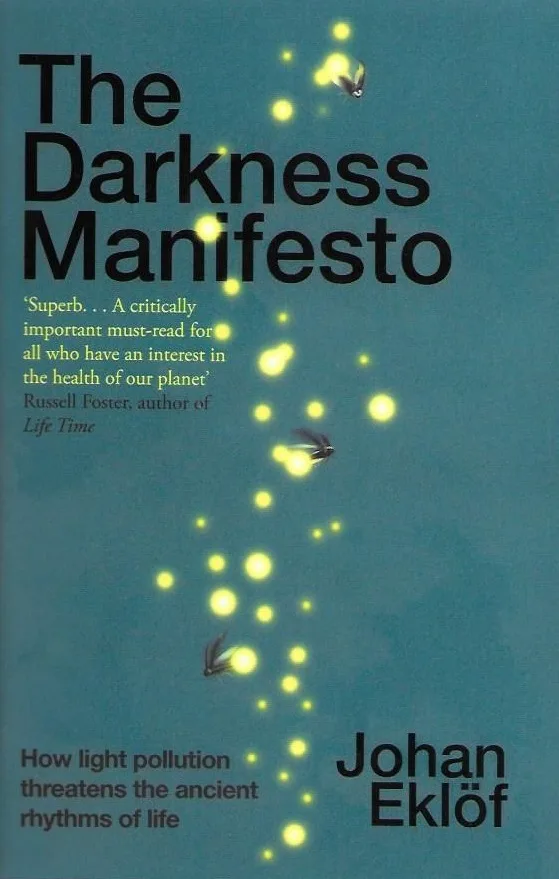
The reason for Johan being interviewed for the podcast was his recent book ‘The Darkness Manifesto – how light pollution threatens the ancient rhythms of life’. But ‘ancient’ doesn’t really cut it; as Johan points out, eyes and vision started to develop around 540 million years ago. In my view (hah!), ‘ancient’ means the likes of Mesopotamian and Chinese cultures, and they were around a mere 5000 years ago, almost the day before yesterday. Our relationship with light and dark was established a long time earlier than ‘ancient’.
Having a cavil about a word in a book title may sound pedantic (well – yes – that’s what cavilling is all about!), but anything that comes from ‘ancient’ times sounds suspiciously like a cultural construct (like ancient religious texts, for example), whereas something that has its roots back in the early days of our very making must be a thing that is innate. It’s within us. And if we’re now doing things that disrupt something so fundamental to our well-being, then that’s bad news. Culture is malleable – nature ain’t. Changing nature takes a time- a long, long, time.
So – the book:
Johan is a great enthusiast for darkness. In years to come perhaps he could be described as the forerunner of a new species of homo nocte. And he certainly does not see our relationship with darkness as a cultural one; he makes the point well that millions of years of developing vision essentially anchors a species’ relationship within the cycle of light and dark.
Humankind has evolved as a diurnal creature; we don’t do darkness very well and have been taught to avoid it by those organised religions in the near East who created an artificial conflict between light (good) and darkness (bad). Round the other side of the world, of course, the early Taoists were putting together the concept of yin and yang, appreciating that you can’t have one without the other (like love and marriage; horse and carriage) – and there’s good and bad in both. ( Now there are a couple of cultural constructs for you.)
.

.
The Darkness Manifesto calls for an understanding on the part of the human race to re-embrace darkness as an active part of our lives. For us, the dance between light and dark helps to keep our internal body clocks ticking in harmony with the planet. And many, many of the species that share the planet with us are nocturnal creatures that have work to do . . . though we may prefer not to know or care about what they get up to, just wishing that they’d do it somewhere else.
Fortunately for us, much of the work that these little guys get up to helps put food on our tables. And if light pollution is a problem for them, then it’s also a problem for us. A very big problem.
I can’t help feeling that there is a huge disconnect between the way that we use everything on this planet and the extent to which we understand what all those other things might be doing for us. I came across this quotation from HP Lovecraft the other day. Lovecraft, if you don’t know his oeuvre, was a writer at the beginning of the 20th century who wrote ‘weird, science, fantasy and horror fiction’, as Wikipedia describes it. He was the one author that I couldn’t read in bed. Altogether too scary. Anyway, he was a disturbed individual with a lot going on for him, which might explain things. The opening paragraph of his chilling ‘The Call of Cthulhu’ reads:
“The most merciful thing in the world, I think, is the inability of the human mind to correlate all its contents. We live on a placid island of ignorance in the midst of black seas of infinity, and it was not meant that we should voyage far. The sciences, each straining in its own direction, have hitherto harmed us little; but some day the piecing together of dissociated knowledge will open up such terrifying vistas of reality, and of our frightful position therein, that we shall either go mad from the revelation or flee from the deadly light into the peace and safety of a new dark age.”
Yeah – OK, thanks Howard. The inclusion of that merciful’ at the beginning there doesn’t really help!
.
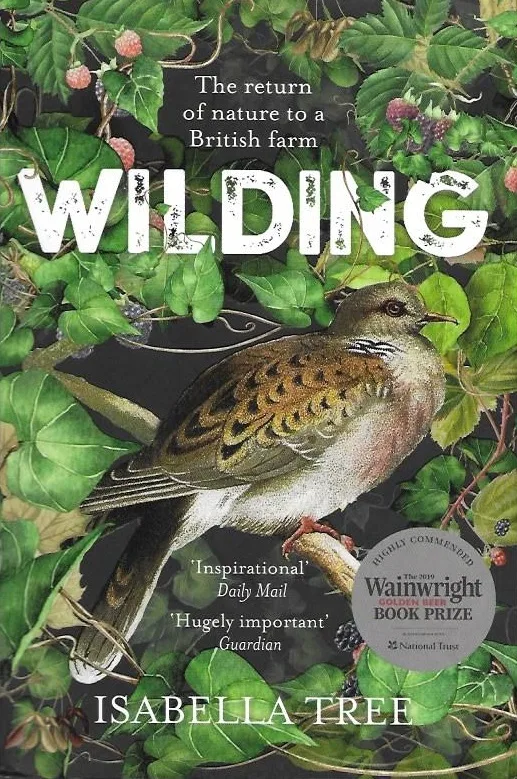
As coincidence would have it, when I picked up The Darkness Manifesto, I was already halfway through Isabella Tree’s book ‘Wilding’ – the story of her family’s adventure in turning exhausted, ‘traditional’, farmland at the Knepp Castle Estate in West Sussex into a rich and vibrant habitat for free-roaming animals, birds, and insects. If you’re looking for anything that describes, in stark and simple terms, what we’ve been doing wrong with our agriculture for the past century, this is the book for you. On the day that I opened The Darkness Manifesto I also read about the ‘rocketing number of bats’ that had been recorded at the Knepp estate as a consequence of the land being returned to nature, just eight years after the end of intensive farming.
Why this matters? Human activity from intensive farming, with its pesticides and herbicides, to us playing fast and loose with night-time lighting, is leading to a collapse in pollinating species, disrupting the food-chain (where we sit at the top table). That is leading to a reduction in food production and over-use of fertilisers. Rich earth is turning into sterile ‘dirt’, good for nothing more than standing the crops up in.
The Darkness Manifesto, and Wilding, are pleas for us to turn our misdirection around while we still have time to do something about it. Light pollution is the easiest thing to do something about because it’s just a case of switching off the lights that are doing nothing other than feeding our insecurities and our pride/arrogance.
I’ll finish with a bit of nonsense that Johan mentions – and I felt obliged to check it out because it’s one of those crazy things where you go ‘how do spell ‘hubris’ again . . . maybe in Chinese?’
China is considering the replacement of its street lighting in Chengdou with an orbiting mirror – an artificial moon that will shine constantly on the city. The satellite would be capable of illuminating an area with a diameter of between 10km and 80km (that’s some range), reducing electricity costs by over a billion yen per year. Its anticipated that the light from the satellite will be eight times brighter than that of the real moon. Two other ‘moons’ are also planned. Of course, there are species that only feed or mate at new moon, so that’ll be them done for. But at least it’s a way of saving energy.
It’s a long way from the classic Chinese Taoist principles set out in the Tao Te Ching, which emphasises the unity of Heaven (Yang) and Earth (Yin), humans, all creatures, society, physical and mental substance. Where our three greatest treasures are simplicity, patience and compassion.
And though that may be just a cultural construct as well. it works for me..
.
.
If you’ve managed to get this far – I thank you.
The Darkness Manifesto, by Johan Eklöf is published by The Bodley Head. ISBN: 978-1-8479-2715-6
Wilding, by Isabella Tree, is published by Picador. ISBN: 978-1-5098-0510-5
.
.