

.
This year’s Circular Lighting Live conference had a very different feel to it. Not because of the change in venue, though The Royal College of Physicians comes with a certain vibe, but because of the sense that Something Has Changed.
.

.
The 2023 edition of CLL felt more confident – more comfortable in its skin, if you like. It was the difference between asking an audience to please believe what you have to tell them because one day soon this would be important, and talking to an audience who had already bought the story, had taken action, and wanted to know more about what they need to do next. This was a conference that was sharing lived experiences, rather than peddling a dream.
Hmm. ‘dream’ may not be the best word to describe what the Circular Economy brings to the manufacturing (and specifying) process, but let’s stay positive, shall we.
Hmm. ‘dream’ may not be the best word to describe what the Circular Economy brings to the manufacturing (and specifying) process, but let’s stay positive, shall we.
Recolight did a wonderful job of organising the day but I have to admit to confusion and some frustration at the decision to have two conference streams in the morning, one for Designers, the other for Manufacturers. What to do? Last time I looked I was still a practicing lighting designer, but I suspected that the real action was taking place in the main hall with the manufacturers. So apologies to my confreres (et consœurs) for turning my back on whatever was going on in the other room. I hear that it was very good. Meantime, I was feeling the heat in the room where the news was that some very big decisions would need to be made once everyone got back to their offices.
.
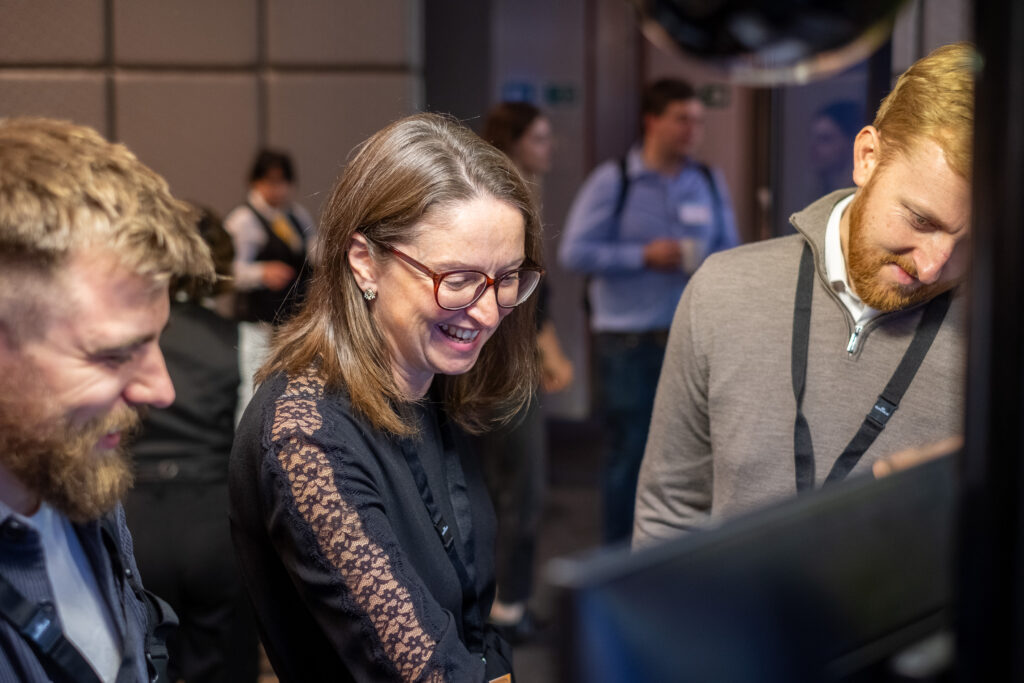

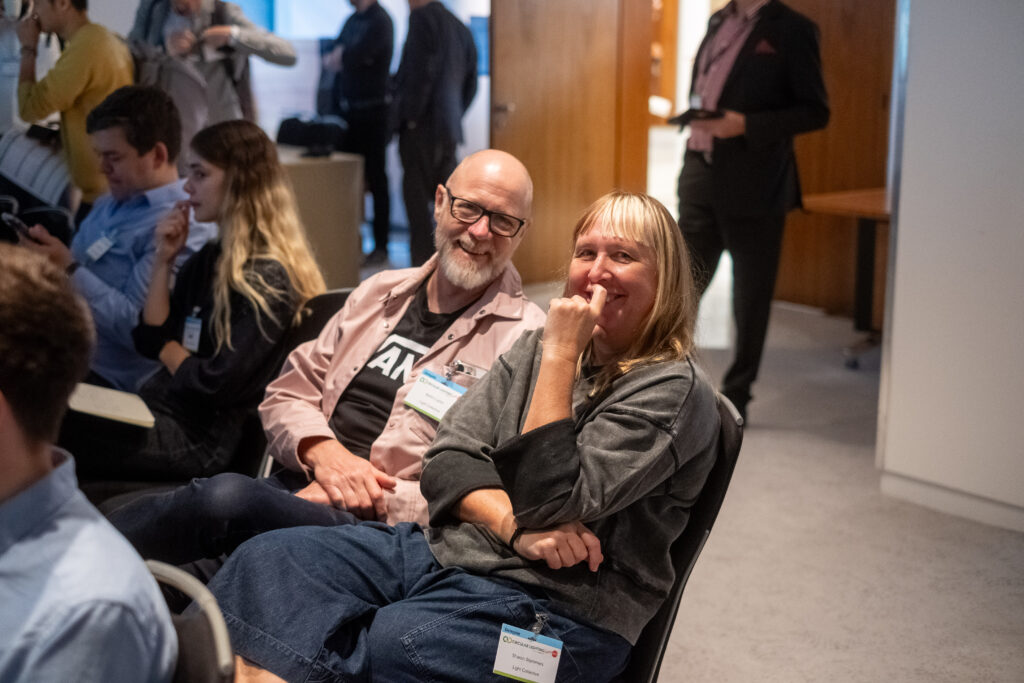
.
When I first started speaking about the importance of Sustainability to exhibition and conference audiences the most common reaction was ‘why should we care; you’re the only one who ever talks about this stuff.” Well, everyone’s talking about it now.
A peen that has dropped for conference organisers is that we need to listen to other professionals, outside of the lighting bubble. And that’s the reason why the keynote presentation was given by Melanie Martin of architectural practice, ORMS. She really set the scene for what was to come later in the day. Here are a few ideas for you to chew over:
- in-house (ORMS) research shows that differences can be made in product and material specification to achieve net zero carbon emissions; it actually works.
- designing for deconstruction is an active goal; it’s a real thing.
- certification is important: Material with Identity is the aim; to measure it is to know it.
- We need light-touch refurbishment; just doing what’s necessary and no more.
Unpack those a bit more and it comes down to this: we now know that we can do this, but we need the documentation and the actual product quality if we’re to build projects that last. And I’ve deliberately put ‘documentation’ ahead of ‘product quality’ because it will be the data that gets a product specified, not a sample fixture.
Mind you, there were a couple of warning shots as well:
- you have to pick your battles
- with salvage – you get what you get.
What’s going on here? There’s a fundamentalist in all of us; battles can be fought over energy efficacy; aesthetics; embedded carbon; lumen performance. In practical terms, we may need to be a bit more flexible – a bit more forgiving. As someone almost said, don’t sacrifice the good in a struggle for the best. We don’t have the time for perfection; we need immediate action that takes us in the right direction.
Here’s an analogy for you – sort of: the Fibonacci Series (1-2-3-5-8-13-21-34-55-89-etc) tends towards the Golden Mean. If you divide the previous number by the next number in the sequence you will get closer and closer to the perfect Golden Mean – but you’ll never get there; it goes on forever. Let’s just agree that three decimal figures will do, and crack on)
We didn’t have to wait too long for the scariest part of the day, because it came straight after the keynote address. Just as we were starting to get comfortable, Maurice Maes of Signify, having been given the unenviable task of speaking about an expected ‘avalanche’ of new (green) regulations, pulled no punches.
The situation is not akin to an avalanche, we were told. Avalanches tend to appear suddenly, do lots of damage – and then stop. A better term would be tsunami. Tidal waves keep on coming. You think you’ve got over the first one but, before you’re back on your feet, the next one makes landfall – and so it continues. We are looking at a situation that we’ve never seen before. And, while these changes are coming from the EU and don’t strictly relate to the UK, is there anyone in the UK who thinks they can survive without being able to access the European marketplace.
Let’s look at two words that describe the coming legislation:
.
REQUIREMENT
The EU is replacing ‘directives’ with ‘regulations’. That’s simple. It means that you won’t have a choice. You might ignore a directive; you won’t get the chance to ignore a regulation.
Any green claims will have to be supported by hard information; such claims are to be real and proven. Marketing directors please note.
The principle for meeting regulations will be ‘do no specific harm’. Know what your products are capable of; ‘harm’ can go a long way. Oh, and make sure that end-users will have a ‘right to repair’.
.
PROVENANCE
Data – data – and more data.
Manufacturers need to get ready for compliance:
- To know what’s coming
- To be able to plan ahead
- To inform, and learn from, the extended supply chain
- To be able to manage product data
- To look forward to demands for third party assessment, EPDs and the like. TM66, as a self-assessment tool, will not cut the mustard once these regulations come into force.
- And understand that it won’t be manufacturers trying to convince the client that the green revolution is a good thing – the clients will be ahead of us, making their own demands.
Maurice played bad cop to Melanie’s good cop. It was the same message, but without a softly, softly approach. E need to do much better; even those of use who are already doing loads of eco-stuff.
.
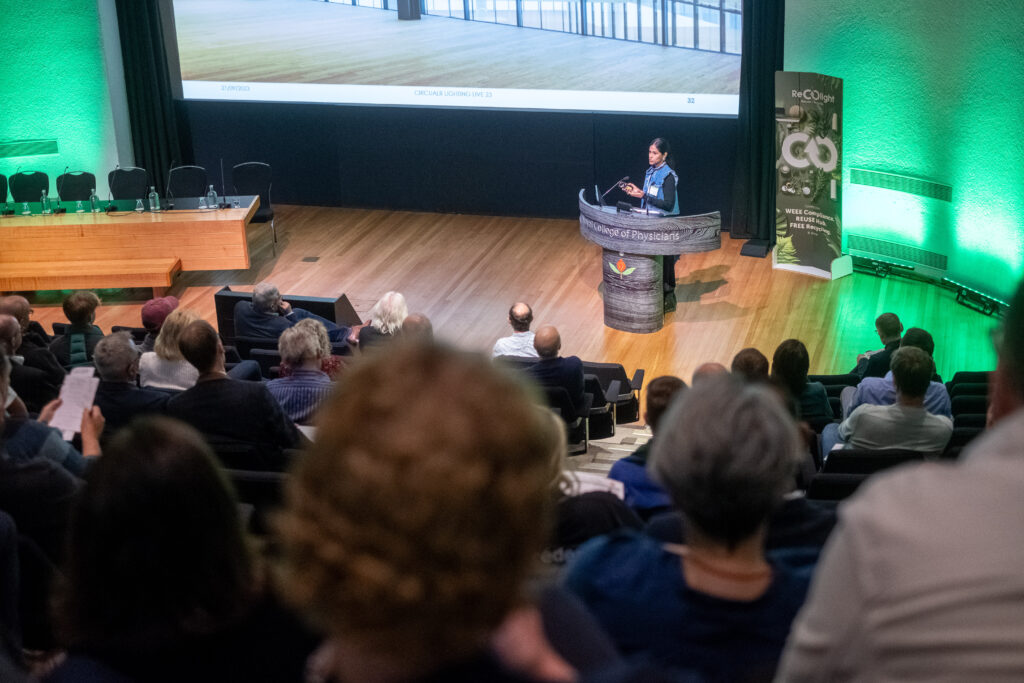

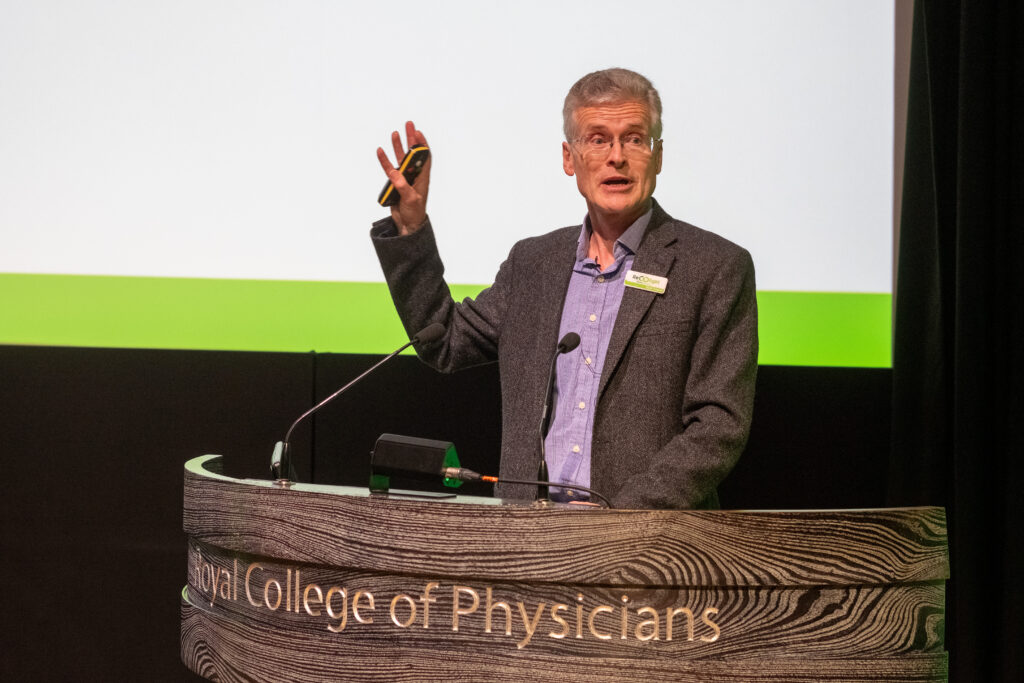
Good cop – bad cop: Melanie Martin (ORMS) and Maurice Maes (Signify)
At this stage, Maurice explained that we’re not experiencing something that is unique. When a presenter flashes up the graph showing the five stages of grief , you KNOW we’re in trouble. The only positive to take from all of this . . . the sooner everyone gets on board the sooner the pain will be over. Maurice called for a ‘sensible embracing’ of this new regulatory world.
.

.That’s one hell of a journey. Maybe if we ever became proper grown-ups we’d just head North-East from Shock to Reintegration, missing out all the crap in between. Now there’s a day for us to dream about!
After that opening, we needed to hear from our friends who are actually on the journey, so thanks are due to David Clements of Future Design and Tim Bowes of Whitecroft Lighting, and with a very special mention for Bob Bohannan who, at almost less then a minute’s notice, took over Nick Griffin’s presentation (Nick had been struck down with Covid) on how circularity was being introduced to the national strategy for roads.
I appreciated David Clements’ comment that what a positive future means for us is more collaboration between manufacturing companies. This was made more evident as the afternoon sessions delved into Recolight’s own chosen territory, that of remanufacturing. Nigel Harvey railed (insofar as Nigel rails at anything) at the iniquitous practice of fitting-out new offices (catA fit-outs), only for those luminaires to be ripped out once a tenant takes the space and actually defines how the space needs to be lit. We really need to get to grips with this because the extent of product wastage is, quite frankly, obscene.
We’ve been expecting an initiative of some sort from Recolight to address the issue of how we get old / unused / unwanted luminaires back into the marketplace rather than have them on a conveyor belt to be broken up at a WEEE recycling plant (TLR reference)
Fran Cameron took us through Recolight’s Reuse Hub. This is an online initiative that really will call for collaboration between companies. To put a complex plan as simply as I can manage: the Reuse Hub is a database of redundant luminaires (As well as other components, such as drivers and LED light engines) Manufacturers and other stockholders will report redundant stock and enter the details into the database. The database will then be open to specifiers and likely beneficiaries of equipment who are looking for . . . whatever they can get (Melanie Martin refers, above).
Nigel Harvey ended his presentation with, quite deliberately I suspect, the clarion call for the day – ‘Action This Day’.
.
According to Wikipedia, this was the note attached to a memorandum sent to Churchill in 1941, from Bletchley Park, which was crucially short of staff. Churchill later took up the ‘Action This Day’ tag on those occasions where he required immediate action.
As Nigel out it, we do not want to turn up at next year’s Circular Lighting Live 2024 conference to hear that we’re still in the same situation. We are moving forward; we need to build on that impetus and aim of yet higher ground
So all I can do, to finish off this review, is to echo Nigel’s (and Churchill’s) demand in a larger typeface:
.
ACTION THIS DAY!
.
.
.
