

In a perfect world, everything we made would be able to be easily upgraded, reused, re purposed or recycled, but guess what, just in case you hadn’t noticed, we don’t live in a perfect world. And we need Remanufacturing.
.
.
My first brush with a Remanufacturing company was when looking locally for lighting suppliers for a project I was working on. Searching for their design office, I eventually found one engineer in a darkened room (think of someone like Back to the Future’s Doc Brown, or Rick from ‘Rick and Morty’) repairing and altering what appeared to be several very old pendants. It turned out a large bank had decided that the pendants had become synonymous with their brand and so they wanted to keep them, even if they were falling apart.
How can a company survive on just repairing a few fittings, I thought, I mean to say, I love the idea to reuse and ‘update’, but a number of questions arose such as – is there any photometric data? Who is going to take responsibility for the warranty, the electrical safety, the lighting design? Would they even perform at the same level?
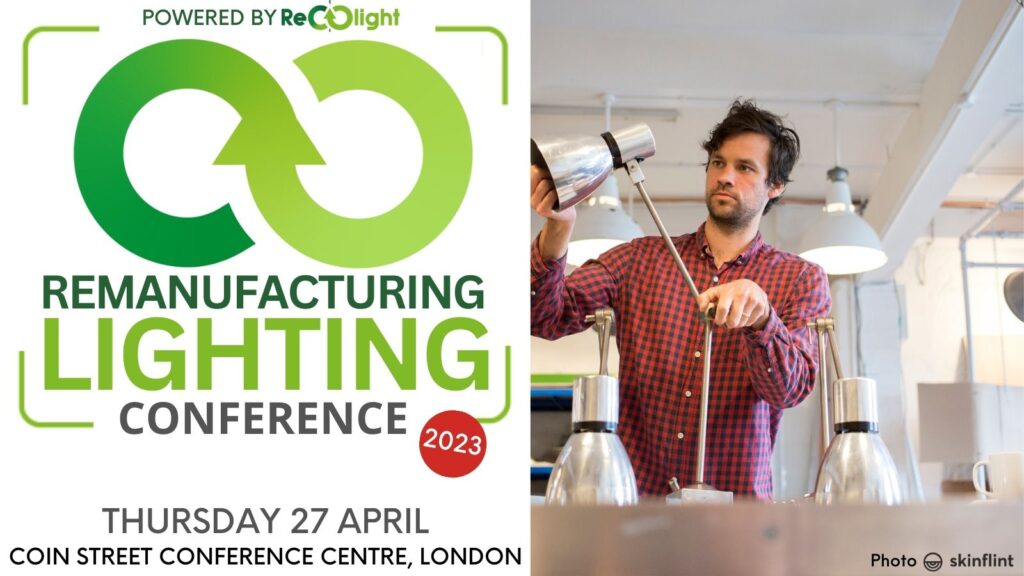
Fast forward 10 years and I am sitting in Recolight’s first ever remanufacturing conference, looking at what the future holds for this sector, and a lot has changed. The conference featured those in the industry who are producing remanufactured products, presentating alongside lighting designers who have used them in projects, giving us all an insight into what exactly it takes, and why it’s important.
Starting proceedings was ‘The Regen Initiative’, a company conceived by F Mark and Coco Lighting and now partnered with Eco Fix UK. The company breathes life into existing fixtures, and the presentation focused on the benefit to clients and how to sell the concept. Since the advent of LEDs, one of the largest driving factors to remanufacture from old fluorescent stock is the ability to save energy, and thus MONEY for the end client. There is also an increasing impetus from consultancies such as Arup, BDP, WSP, Hoare Lea etc for solutions that encapsulate a more sustainable approach.
Because of this reduction in power when changing from fluorescent, alongside the reuse of existing materials from remanufactured lights, we can avoid having to dig raw materials out of the ground (often transporting them halfway round the world) and diminish the amount of carbon being chucked out in the atmosphere. All in all, a good news story for the planet, and something that big business now understands can improve their corporate image, attracting more customers.
Broader benefits available that can also be added during the process are elements such as updating the emergency, daylighting and wireless controls, though one thing that struck me was how varied methodologies could be – and how that anyone considering a remanufactured solution would be wise to go with a trusted partner, as everything really needs to go like clockwork.
Why’s that? I hear you ask. Well, in most of the example projects shown the products being re-conditioned were, as you might imagine, in spaces already being used. And that means that, if the process isn’t slick and speedy, you are going to be left with employees being left in the dark.
In the case of Future Designs in a case study that was presented, the company set up a full test system in the car park, with a comprehensive testing bay that was the mirror of their assembly plant in Kent, ensuring that every product was tested before being re-installed. Like a mad game of office Tetris, lighting in sections was taken down in the night, and then refurbished during the day, to be installed the following night. Offices occupants were obliged to move to different areas during the work, so you can imagine the importance to keep everything slick.
As alluded to previously, one thing that I really wanted to know from my musings all those years ago, concerned the compliance of the fittings, and whether or not they would have any photometric data.
One of the presenters, Tom Ruddell of EGG Lighting gave a clear answer, that was ‘All the same legislation applies to a remanufactured product as a new product’. Which is great news for the lighting designers, removing as it does an valid reason not to specify. In fact, all the presenters were keen to present their remanufacturing process credentials in this respect, unsurprising but still good to see.
In respect to photometric data, I think that this will really depend on the type of application that the remanufactured products are going to be used in. I gather it will be down to the overall cost implications on the project. As you can imagine, more than one of the presenters mentioned the scale of the project involved in determining whether a remanufactured approach was viable.
EGG presented an interesting list of differences to specifying remanufactured products, compared with new products. For example, they stated that they may have less time to carry out compliance activities, samples would be limited, testing would be ideally non-destructive (Well, you know there is no limit to what clients can ask!) and, interestingly, that some costs could be higher where there are smaller volumes. They also described photometrics as an ‘interesting challenge!’ and stated that they may be standard, although lord only knows what that means.
The sense I get is that in some respects it may be useful to consider remanufactured products in the same way as you would a bespoke fitting, as I feel that many of the same aspects apply. And as for us designers . . . how do we fit in? Cundall’s Natalia Duffy was on hand to explain how she met the design challenge.
Asking the question from the off whether the design should encapsulate a reduction in carbon, energy and waste or something more, no prizes for which of those options was preferable. After all why employ a lighting consultancy unless you want something more!? Cundall’s approach is to set out lighting design criteria, improve the existing lit environment and conduct a life cycle analysis, which I mention here as it highlights the fact that using remanufactured lights doesn’t mean that you are restricted to bog standard solutions. In Cundall’s example, the design also requried the addition of circadian lighting.
The lighting design, as well as improving the lit environment, also halved the carbon over its whole life, which is a massive plus and just goes to show what you can do with used remanufactured products.
In conclusion, the fact that re-manufacture now has a formal framework soon to be finalised in the forthcoming BS8887, which we hope to see published before the end of this year, means that this market can only develop and grow. While currently there is no guarantee that a re-manufactured product will always be cheaper to purchase (viewed in CAPEX terms), history has shown that as technology improves and raw materials become scarcer, the price of remanufactured products will become more competitive.
The price is one thing but let’s not lose sight of the real win here, that more companies re-manufacturing existing products is a massive benefit for the environment. According to a recent report from the world meteorological association ‘There is a 66% likelihood that the annual average near-surface global temperature between 2023 and 2027 will be more than 1.5°C above pre-industrial levels for at least one year. ‘ so the more remanufacturers the merrier, the world we all share currently needs all the help it can get.
.
.