

Moral behaviour or ethical behaviour, what’s the difference?
.
It’s said that Morals define GOOD from BAD; RIGHT from WRONG, while Ethics relate to moral character, usually within a specific social framework.
So, before we can build an ethical position we need to establish a moral foundation.
Seems reasonable – and why do I want to talk about the Morality of Lighting anyway? Because it gets to the nub of a problem.
And why am I writing about this now? It’s because a couple of things have come up that have set off an itch that I need to scratch. I want to write about an assumed position of ‘moral neutrality’ within what we do. It leads me to my own Lineker Moment because I’m about to make a potential dodgy comparison with something far worse, but which – I believe – lives along the same spectrum. But we’ll come to that in a moment.
A couple of things came together this week:
At the beginning of this year, ILP published its Lighting Guide 05: The Brightness of Illuminated Advertisements including Digital Displays. This fine piece of work, prepared by Allan Howard, Peter Raynham, Karolina Zielinska-Dabkowska and Henk Stolk, looks in detail at the way that illuminated advertisements work, how they interact/interfere with the (predominantly) urban environment. The Guide goes so far as to suggest ways in which LED optical technology needs to be developed to mitigate the way that these objects unduly affect the natural world, light pollution in particular.
It’s the kind of document that most of us take a quick look at and then file away for the day when a public realm project comes in – and might be expected to incorporate illuminated advertising technology. So far, so not unusual. We are, if nothing else, inherently lazy.
But then another reason came along that obliged me to read through LG05. I was invited to co-host a podcast with Charlotte Gage of AdFree Cities. Charlotte had been invited to join Michal Colligan’s Restoring Darkness podcast series and Michael invited me along for the conversation.
You can see the podcast ‘Advertising Light Pollution‘ below.
.
My Lineker moment:
In the same way that ‘it’s not guns that kill people; its people who kill people’ – let me suggest that, as an industry, we have a parallel in ‘it’s not light that distorts our reality and makes consumer slaves of us all; it’s the illuminated advertisements that distort our reality and make consumer slaves of us all’. I appreciate that the comparison is not exactly Route 1 to National Socialism vis Sunak’s government, but it hurts to think that we may be doing things that make life worse for the people around us (and, likely, at some level to ourselves).
The alternative narrative that life would be better with no guns (or inappropriate lighting) is rarely heard outside of community pressure groups. The mental and emotional anguish relating to invasive advertising imagery is not heard.
.
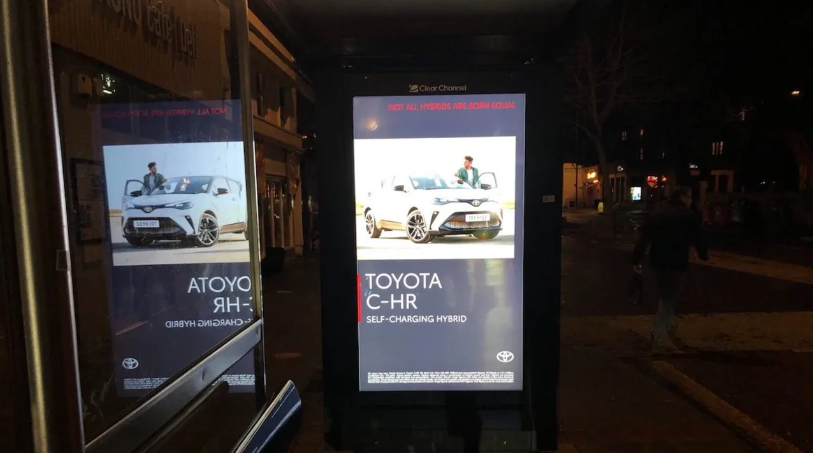
Let’s look briefly at the headline issue for AdFree cities:
“Advertising impacts us in many ways, whether through manipulating us unconsciously or encouraging excessive consumption which is damaging our environment and wellbeing.”
We prefer to think that advertising is innocuous; it’s something that’s there in the background, like visual muzak – just lots of images in pretty colours; no different to a municipal flower bed (remember those?). But if that were the case, why would global companies commit millions and millions of pounds into pushing those images into our brains. Think on this; the research on circadian lighting opened up our understanding into what happens throughout the body when light enters our eyes. But we still tend to talk only about light colour and light intensity – and the times of day when it all happens.
But look at biophilic design. It’s widely recognised that simple static images, such as photographs, can affect our well-being. ‘I think that I shall never see, a poem lovely as a tree’, wrote Joyce Kilmer in 1913 – and it’s true! We never will see a poem as lovely as a tree. It is acknowledged that ‘biophilic’ imagery produces physiological and psychological benefits that enhance our cognitive functions and impact on our emotional state of being.
So what does the visual imagery of illuminated advertisements produce in us? All those images of the perfect body; of idealised life styles; of fast-food and quick-fixes. We’re assailed with impossible imagery – of things beyond our reach and the only option we’re offered is to buy and keep buying into that impossible world. When we’re never satisfied, because that’s not the aim of the advertisers.
.

It’s time to say it. As lighters we have a simple starting point: FIRST: DO NO HARM.
If that means anything at all then we need to look at the morality behind the uses to which Light is put. Its not about censoring this or that; and allowing that and this. Its about acknowledging that, on occasion, Light is used to ill intent. Advertising serves little or no positive purpose for the wellbeing of the general public, illuminated advertising even less so. We should be allowed to go about our daily lives without having these cyclopian monsters taking up physical, visual, mental space in our public realm.
This may sound a bit radical, but I feel that the next edition of LG05: Lighting Guide 05: The Brightness of Illuminated Advertisements should just read: ‘Not wanted here. Thank you.’
Let’s make it a bit more technical, if you prefer. I’m sure that, if we tried, we could come up with a Health and Wellbeing equivalent to Lighting Environment Zones. All we’d need to do is to rate our high streets and public space as E0 zones, permitting zero luminance from any advertising material, in all instances.
The lighting industry has a good record when it comes to Light affecting the physical body – appropriate illuminance levels for particular tasks is the obvious example. The WELL Building Standard establishes lighting design criteria that address disruptions to the body’s circadian rhythm, aiming to improve energy, mood and productivity.
We can see from the progressive work that’s being done on health and wellbeing that we’re in touching distance of considering the emotional impact of Light. Acknowledging that Light is having a detrimental effect in the area of visual messaging could be the next step.
.

.
I’ve borrowed a few quotes from the AdFree cities material, just to open up the discussion a bit further:
Under the influence
“The conscious and intelligent manipulation of the organised habits and opinions of the masses is an important element in democratic society” – Edward Bernays (pioneer in the field of public relations and propaganda)
The feel good factor
“Contemporary marketing techniques that link products with positive stimuli can elicit a preference for or choice of that product by non-conscious, non-rational means, and may even undermine consciously held attitudes.” Nairn and Fine 2008 – Agnes Nairn, researcher in the field of marketing and children; Cordelia Fine, researcher in psychology and cognitive neuroscience
A cycle of unhappiness
“It often seems to me that a person who feels happy and secure isn’t going to be a very good consumer; because that person isn’t going to be looking for products to shore up their self-image or to feel better about oneself.” Jean Kilbourne, pioneering activist on the image of women in advertising
The beauty myth
“Women see face and the Body all around them now … because advertisers need to sell products in a free-for-all of imagery bombardment intent on lowering women’s self-esteem.” Naomi Wolf, author of The Beauty Myth.
Spend Spend Spend
“Driven by the pressure placed on us to continue spending and the desires created through advertising many of us have chosen to borrow to supplement our wages which, despite working longer hours for many, have decreased in real terms.” The Advertising Effect by Compass (2009)
.
.
.