

I recently provided an overview on the progress being made to develop a lighting specific version of BS8887 (Recolight webinar: Designing sustainable luminaires), the BSI standard that is being developed to demonstrate a practical platform for used / obsolete equipment to be re-purposed and returned to active service.
I’ve been asked since then to describe further the way that remanufacturing can work in our industry and what it has to do with the climate emergency. Here we go, hold onto your hats:
Remanufacturing is a core component of any circular economy strategy – and circularity is vital if we’re to get even close to holding carbon emissions within manageable limits. When I say ‘manageable limits’, I mean the limits within which we as a species can continue to function in any way that is recognisable to how we do things at the moment (without the energy excesses).
That is a big ask.
To help with this discussion, the Ellen MacArthur Foundation has re-published its 2019 document ‘Completing the Picture – how the circular economy tackles climate change’.
It’s a serious read with loads of information and I really recommend that you find the time to read it to appreciate the broader picture. And there are some great graphs.
Lighting is a small, yet significant, part of the construction industry. And like small cogs in any complex machine, the machine needs everything in place for it to work properly – it’s that kind of small yet significant. The machine that is the construction industry is made up of many, many, small cogs. And we all need to get behind the Circularity programme.
Everything from hereon is looking at the broader construction industry, based on the EMF report, not just one small cog called ‘lighting’. Don’t let that stop you from reading it.
Why does Circularity matter in achieving climate goals
Most of the conversation at Glasgow (COP26) has been about energy generation in it’s many forms, and how to keep the wheels turning without using fossil fuels. But there is an equally important fact that doesn’t get as much publicity. The key to the whole COP26 discussion is the importance of keeping the global temperature rise to within 1.5°C, which is more or less where we are today, so that means learning to live with continued flooding, droughts, wildfires, tornadoes, melting ice caps . . . and this is meant to be the good bit!
It is reckoned that, in order to hold that temperature increase to 1.5°C, changing the way that we generate energy (removing fossil fuels, finding a reliable way to capture CO2, etc) will still only provide us with 55% of what we need to do. That means we need to look elsewhere for the other 45% – and that’s where we must focus on the way that we make, use and dispose of things – including materials that have an interest for the lighting industry, like steel, aluminium, plastics – and there’s a lot about cement, which might be tangential to us, but it’s a vital component of construction, of course.
Food production is also included – which I won’t talk about here. But read the report to find out what we need to do there. After all, we all eat.
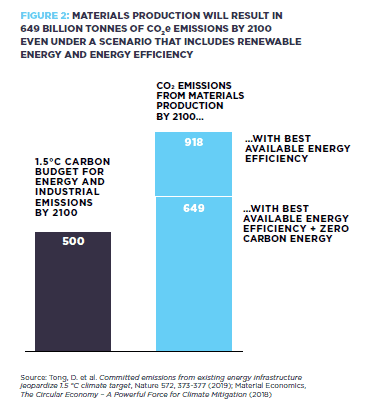
The figures suggest that, even allowing for improvements in the way that things are produced, and even including achieving zero-carbon production methods, emissions from the production of steel, cement, aluminium and plastics ALONE will reach, cumulatively, 649 billion tonnes of CO2e (carbon dioxide equivalent) by 2100. And the problem with that is that the established 2100 carbon budget for energy and industrial emissions comes in at 500 billion tonnes, which will put us just about 30% over the top.
In other words, the numbers don’t add up
To meet climate targets we need to find a best-case way to keep materials in play – recycling is only a partial answer. One of the long-standing issues around recycled metals is the loss of material integrity. Buildings still need to stand up and luminaire reflectors still need to perform.
That means Circularity.
We need to factor in a different way of going about business. We can remove the need for energy in material re-processing and reduce the amount of primary material extraction if we embrace a methodology that enables fabricated components (heat sinks) and structures (luminaire bodies) to be brought back into service once their original purpose has been met. Second-hand lighting, if you like.
Like your second-hand motor, John.
Previous reports from the Ellen MacArthur Foundation have shown that in Europe, India and China, a Circular Economy could reduce greenhouse gases by 22-44% by 2050, if implemented across major sector that includes the built environment.
Remanufacturing is the inevitable – the most logical – outcome of a Circular Economy. With the development of a BS8887 standard for lighting we’re looking to create an approved methodology for re-purposing old luminaires in order to keep them in active use. This will only work provided the broadest client bodies trust the process, and if the original manufacturers also trust the system sufficiently to buy-in to a system of licensed spares and replacements. Hence the need for a BSI standard.
Two words to get used to in this on-going conversation: MODULARITY and INTEROPERABILITY.
New words possibly, but not new concepts. Modularity and interoperability lay at the heart of lighting in the 20th century. Every manufacturer had to design and build products to accept light sources that were made to a global standard, and the accessories (lamp holders, control gear etc) were generally replaceable from a number of companies without recourse to the original manufacturer.
LED developers need to learn how these terms can become commonplace again. The work done by the Zhaga consortium shows the way. Its not the only way, but its an example of how to put one foot in front of the other if you want to get anywhere.
Here’s a final lift from the EMF report: Industry is responsible for around 21% of global CO2e emissions. The use of steel, plastics and aluminium in buildings and in car production (and, let’s face it, that’s another argument.) account for 73% of the emissions from producing these materials. A Circular approach directly challenges the way that we use energy to make light fixtures. It puts us on the right side of the argument.
.