

After a three-year hiatus, Euroluce, the world’s largest design show, is back. The last time this biannual event was held was in 2019, after which Covid struck and – well, we had more important things to worry about!
.
So, what were the highlights and trends . . . and was it well attended? On cue, to solidify my view of the unique pulling power of the show, I had already rubbed shoulders with Italian prime minister Giorgia Meloni and met the Queen of Holland – all on the first day . . . but! All was not rosy as, for the first time at the show, I experienced that sinking feeling, a pang of guilt perhaps that, with the environmental impact of the whole event, these types of mega-show could soon become a thing of the past.
In my wanderings I was pleasantly surprised to find Tom Dixon, it being their first ever appearance at Euroluce. Juliette Greenspan head of marketing and communications kindly took me through what was on offer –
‘The big highlight this year are the new portable lights, all inspired by existing Tom Dixon designs. We have four colours in the melt version and the baby bell (shown above). They are all IP44, so suitable for indoor and outdoor use. They are dimmable and we have worked really hard to ensure they are properly engineered, in the material and functionality. You can expect to get between 8 – 9 hours of battery life.’
.
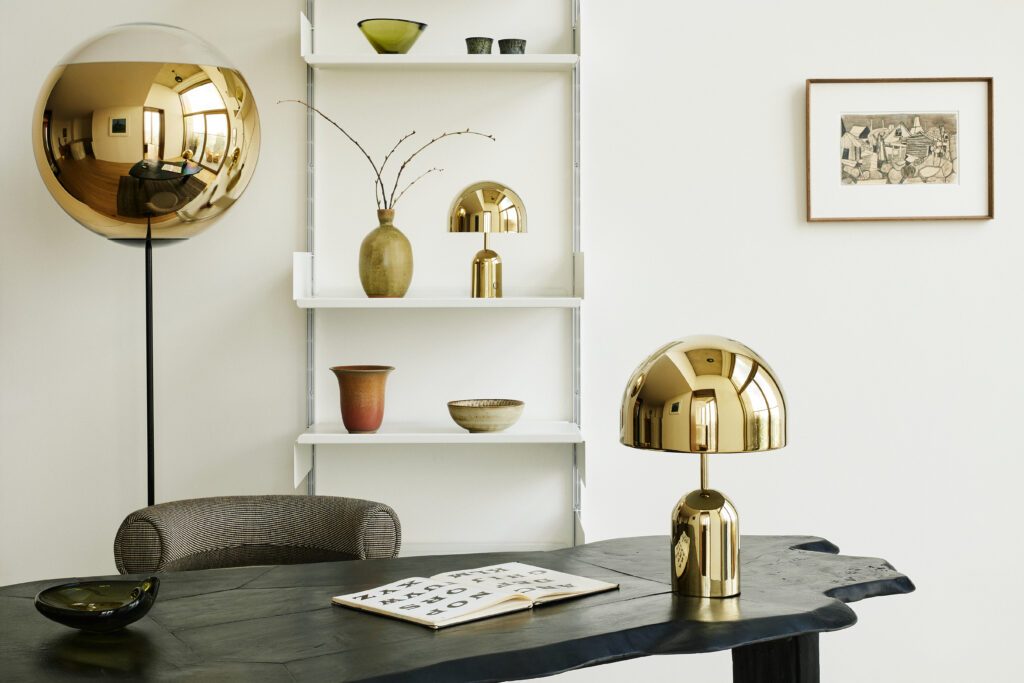
Tom Dixon, Bell portable.
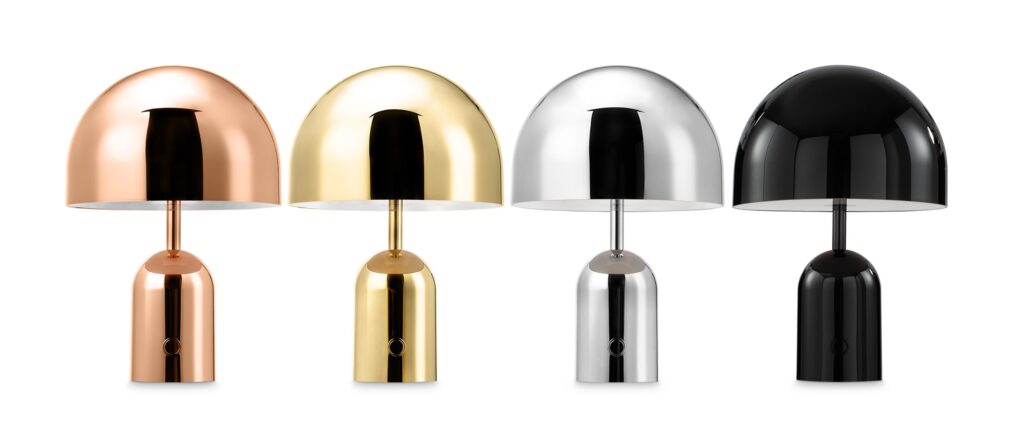
Tom has thought a lot about two aspects here and his design reflects this. We are far more likely to be working from home nowadays and our ways of living are changing; we are always on the move. Not everyone will be able to afford a Bell table light (£550), but this gives the possibility to own a Tom Dixon Bell Portable for a fraction of the cost, with the advantage of greater portability. The LED should last around 15 years, after which it can be changed, the shade is hyper-polished with a concealed light source diffuser. Of course, there are other portable table lamps out there, but this is a quality product which has been designed to last, and handed down in the family. After all, who wouldn’t want to own a Tom Dixon product?!
For those who are unfamiliar with Davide Groppi, where have you been?

His products are playful, imaginative, and frequently surprising, often conveying weightlessness with a minimalist simplicity. And then there’s JUST LIKE A LIGHT (undeclared homage)
The closest comparison to another designer I can think of would be the late Ingo Maurer, I mean apart from these two designers where else could you find a light that utilised something as off piste as 5 miniature toy crocodiles? (As I wrote this I had to check the photo again to make sure I hadn’t been hallucinating. It had been a long week)
At these shows you are always looking for something new and unique, when I was told by the rep on the stand that they had ten new products on show I had to curb his enthusiasm, ok please just show me the best ones then! See the entire Davide Groppi 2023 Salone collection HERE
.
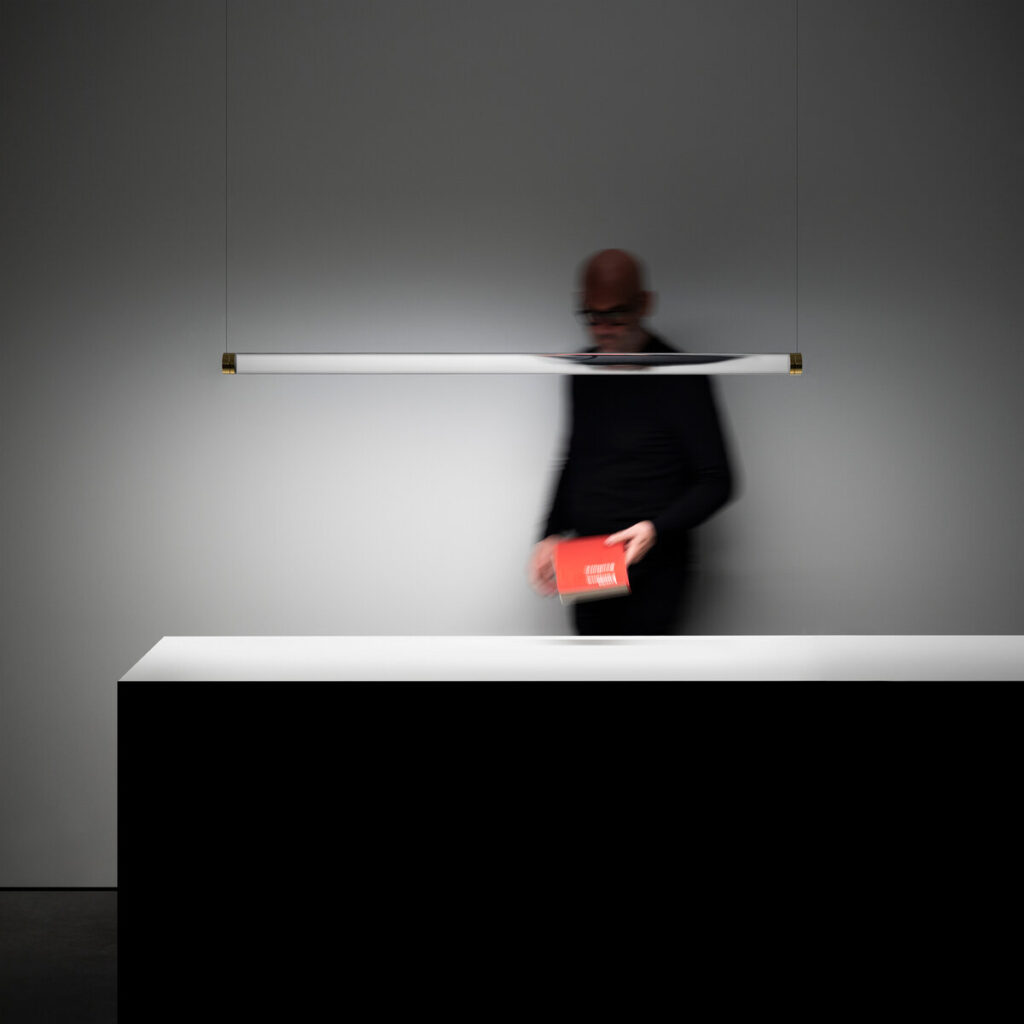
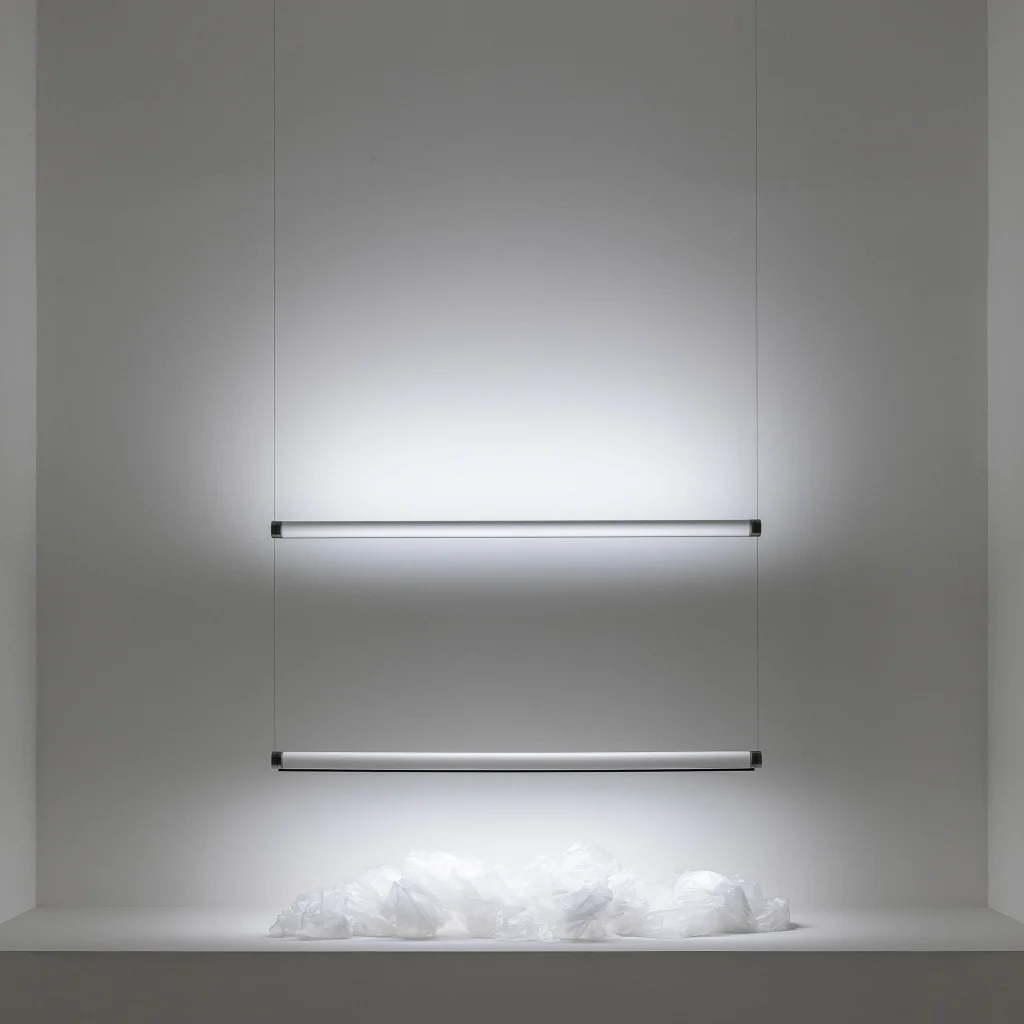
Davide Groppi – Magia Suspension Lamp
Even after careful elimination it was still hard to select my favourite product from their range, but I settled for the ‘Magia’ suspension, designed by Michele Groppi. I love a product that forces you to ask the question, how do they do that? The suspended pendant, consists of a convex suspended lens which as well as distorting your view in the visual scene, also conceals the light source, a thin linear led strip carefully placed along its length, (seen in the photo above or please follow link below). This product would be perfect for a reception, hospitality or even at a push office, (its UGR is TBC). The product is available in polished gold or black chrome finish, with a system flux of 1770lm for 2700K; 1950 lm 3000K.
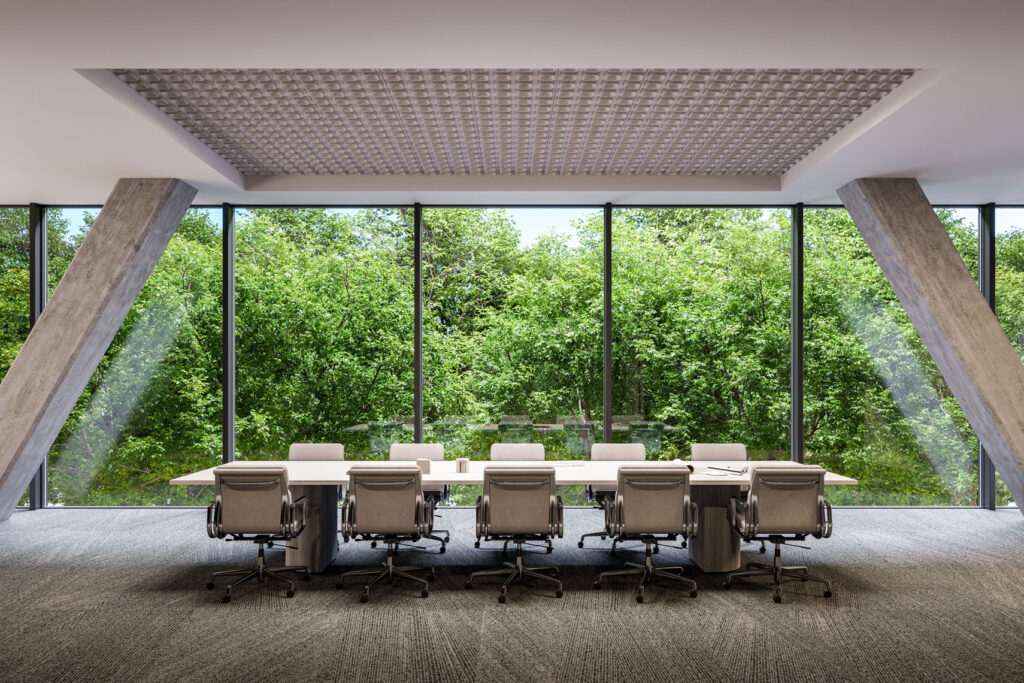
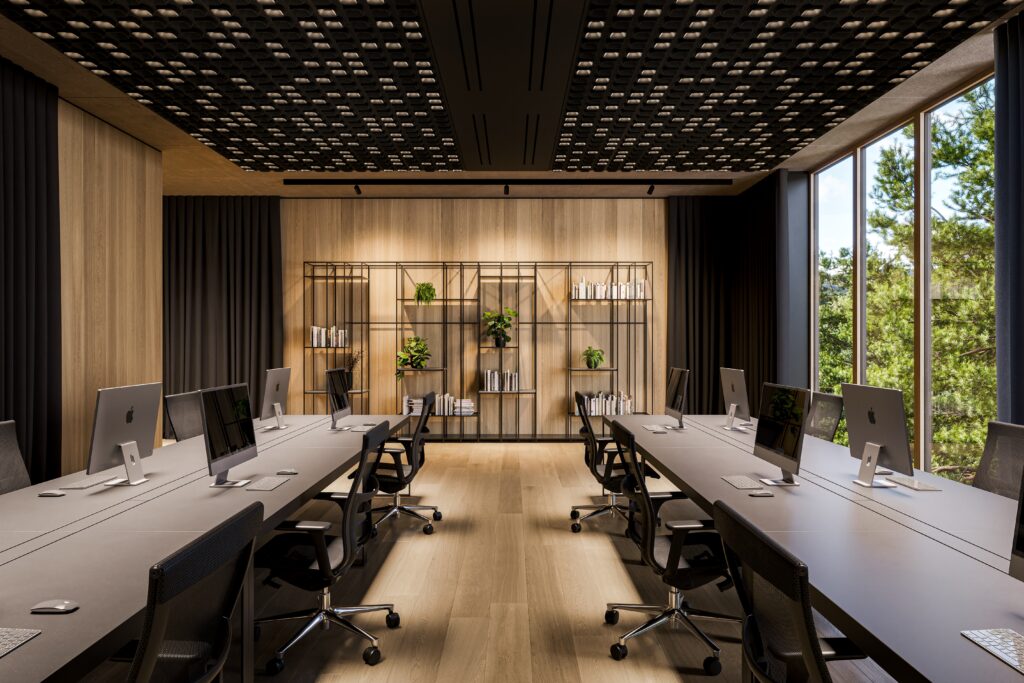
This product on the Intra lighting stand caught my eye, I liked the look of the Vyka product even if I couldn’t get the idea of an egg carton out of my head, what was going on here?! had a chat with Nika Furlan on the stand to find out more about this new product.
‘Vyko comes in four different versions, and is not only a luminaire, but also a ceiling that improves the acoustics. The Bartenbach LFO provides low glare where the light source is virtually invisible, and we also have a decorative option, these both provide a UGR of below <19. Vyko is available in Grey or Black, and in terms of sustainability the product is made from recycled material, 60% for the grey version and 28% for the black.’
.
Intra Lighting – Vyko
There are a few things about this product that I really liked. Firstly, I am increasingly annoyed by noisy offices. Doing take-offs is a good example of this. There’s always one person in a busy office who interrupts and makes me lose count! I love working in spaces that consider the benefits of quiet, and as companies encourage staff to come back to their increasingly empty estates, this could be one of those elements that will increase the likelihood of an otherwise reluctant return.
The design aesthetic changes the whole look of an area and I can appreciate that, I can see companies creating quiet areas in their buildings through use of this kind of acoustic intervention. It provides a nice visual cue, the decorative product being more useful for this than the LFO version. Finally, its sustainability credentials show that the designers at Intra have really thought about this, with the product being 100% recyclable.
.
‘Mood Moon’ by Ingo Maurer framed is available as a wall light or floor standing / leaning, and in my humble opinion is as much a piece of animated art as it is a light. I spoke to the designer Sebastian Hepting, who kindly told me where he got the inspiration for this new light product (although product does seem a bit of a formulaic description).
‘ The Mood Moon belongs to a family of luminaires, inspired in part by a certain interpretation of the Moon. Mood Moon changes the mood of the user through subtle colour changes. This lamp combines analogue and digital elements. The analogue part is expressed through the very high value Japanese paper that we use; it’s beautiful because as the light penetrates the paper it gives a warm shine, a paper product that we often use. The digital technology enables the possibility to change, and animate the colour to produce subtle gradients, to have colour wandering around. We have an app for this luminaire called Ingo Maurer Digital with our own system (downloaded from the internet). When you buy the lamp, it’s a bit like buying an album, you have 14 different moods, accessing all different types of atmospheres.’
.
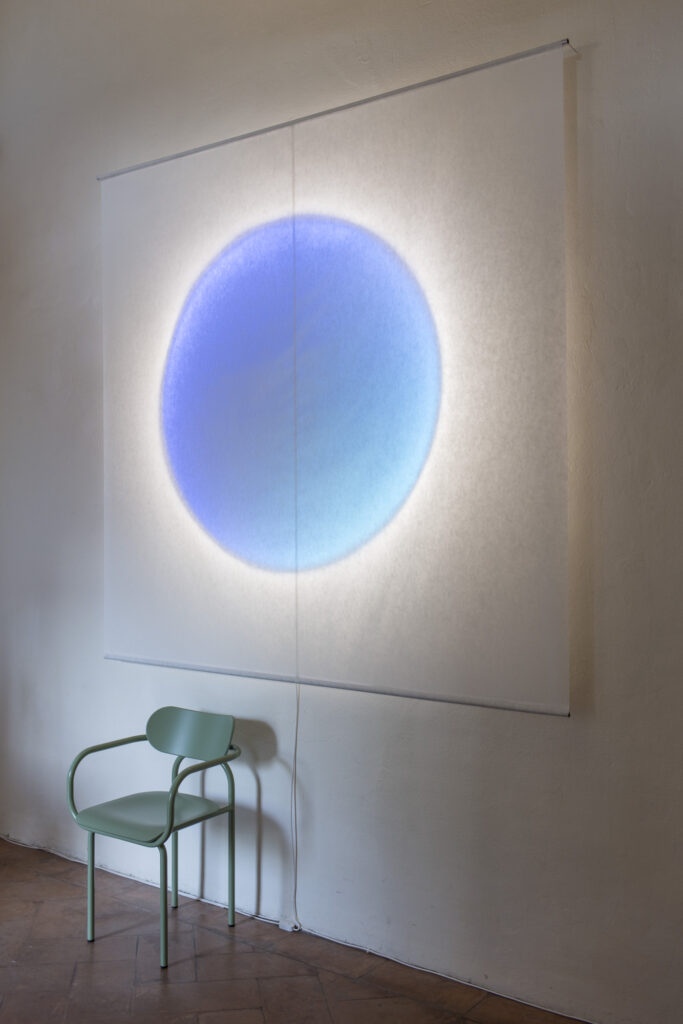
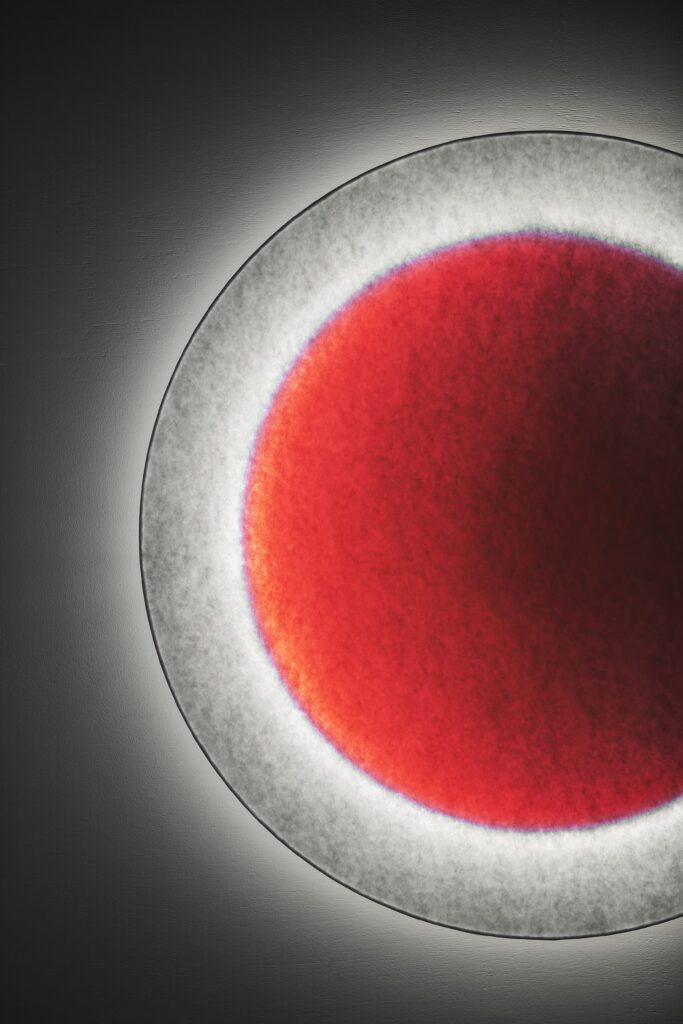
Used leaned up against the wall on the table, or on an easel, the colour change and movement is very subtle. Why so slow and subtle? I am convinced we live in a very fast paced world with sensory overload, Las Vegas everywhere, in the restaurants, on the streets, it just annoying. This product is there to help us slow down, to appreciate the slow movements and peace’.
The product can be dismantled, shades can be replaced, when the lamps finally die they can be resourced through the shop where the product was bought. Designers at Ingo Maurer develop and follow the product all the way through to production which obviously brings great pride. Sebastian had been working with Ingo Maurer for twenty years, something you can see his influenced in this light, somewhat poetic I think!
.
.
With his first product for Flos, Canadian designer Philippe Malouin has designed a simple and tactile product, Bilboquet, which due to its aesthetic nature, almost invites you have a play with it. Inspired by the 16th century French game of the same namet (bilboquet was a game that involved popping a ball on a string to land in a hole or on top of a stick). The top magnetic sphere acts as a joint that allows the upper cylinder to rotate, directing the light. As Philippe Malouin describes –
‘Simple in appearance but full of personality, Bilboquet is an adjustable table lamp that allows you to direct light in a playful yet precise manner. Taking cues from magnetic ball joints, Bilboquet offers a full range of movement for a variety of functions. Whether used as a task light on a desk, or to provide a soft glow against a wall, or directed at a good book, Bilboquet shines light where its needed.’
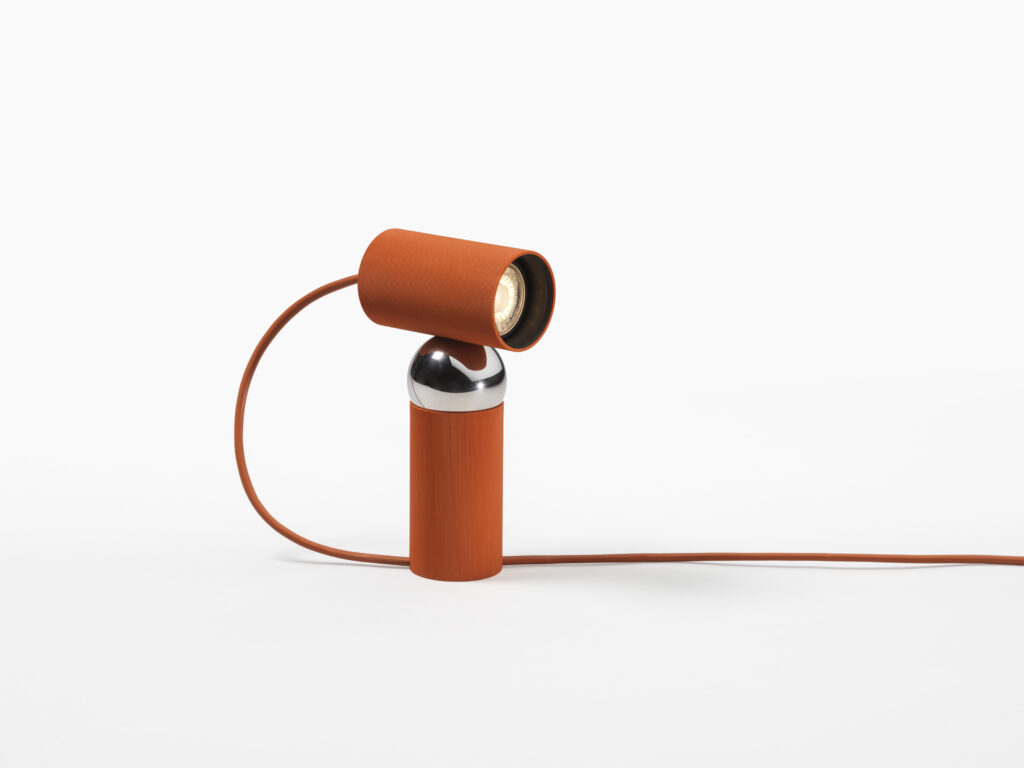

The product is reassuringly heavy, and the serrated edge gives you good grip when moving its position. Available in three colours, sage, tomato and linen, the tomato gives the product a cool 60’s vibe, with the cable and plug in matching colours. The cable can be left free or concealed, locked in a special housing in the base.
In terms of sustainability the product can be easily disassembled and repaired. The retrofit lamp can be replaced / upgraded; and materials do not receive secondary manufacturing finishes to reduce the environmental impact.
.
One thing I was really hoping to find at the fair was a paradigm shift in the approach to exterior lighting. Cariboni provided that shift. The time when we can turn a blind eye to environmental matters, in the vain hope that someone else will sort it out, is over, We can’t ignore the huge negative effect that exterior lighting can have on flora and fauna, and, by extension, our entire way of life.
Mattia Berilli, Export Sales Director was kind enough to run me through their holistic and unique approach, something where every designer could benefit and at the same time benefit the planet.
‘Eco-centric lighting is a technical system developed to protect the flora and fauna during the night-time. We don’t have a product but a solution that we can apply to every product in our catalogue, which is the key point.
Our aim is to protect the night-time environment, and we are passionate about it. Until fairly recently, before the advent of nocturnal lighting, the life cycle of plants trees, insects and fauna followed a pattern that had been unchanged for billions of years. The introduction of artificial light in the last century has changed this cycle for the worse, we keep the lights on even during night-time.
This is changing the lifecycles of birds, fauna and trees, so we have carried out research both internally and externally for the last couple of years, to study how specific animals relate to specific light conditions. Some animals prefer the blue, some the red, so we try to find the best compromise using this data. Some of these colours are found to be acceptable to some species, and not others, for example the owl can accept a lot of blue and no red.
In our eco-centric solutions, we use switchable white, and control the timing that lights are operated. The LEDs operate from 1300K – 1800K to 2000K. We combine the colour temperatures and timings that are required at specific times for the species present in the areas’.
This is a solution where all of the parties will be working closely together in order to achieve the best outcome, meaning its good for the lighting designer, ecologist and the manufacturer, a symbiotic relationship where everyone benefits as well as nature! For anyone who wants to find out more (its not an easy subject) the you tube clip below talks about this in greater depth.
.
.
And finally……
As previously mentioned, I had that nagging feeling, that with over 2000 brands, (34% of them from other countries), 65% of buyers from abroad and over 5400 accredited journalists, this type of event just isn’t going to be sustainable in its current form for much longer.
Travel aside there was a huge amount of waste just involved in the setting up the stands and the ripped apart at the end of the event, as British designer Tom Dixon noted: “It’s a lot of people coming from all over the world – it’s a lot of carbon footprint just embedded in the flights,” he said. “I think we’ve got to rethink completely how we show [products], where we make them, where we transport them to, and the rest of it, but that’s a project which is a 10-year project.”
As design fairs go, Milan is the largest, but we can’t forget that these types of fairs are being replicated globally, albeit on a smaller scale. Organisers at this year’s fair made an effort to use recycled and recyclable materials, had a Sustainability Policy and Green Guidelines, all tied-in with support for the UN Global Compact, and is pending ISO 20121 certification, so welcome steps are being made. But these shows are still dependent on huge numbers of visitors, and rely on the good intentions of the exhibitors to be ‘team players’. Can the model really be considered feasible?
We can’t live in silos, and the experience of touching and feeling products, whilst mixing with our fellow humans, can never be replaced, I love the Salone, but an urgent answer to this sustainability conundrum needs to found soon.