

Circadian lighting has been an outlier in lighting applications for the past decade; there’s always been a feeling that there may be something in it, but it’s been difficult to put a finger on where the actual benefits lie. After all, circadian illumination is just outside the front door – isn’t that good enough?
.
Dr. Shelley James is the UK’s chief advocate for bringing healthful lighting to our artificially illuminated world and she hosts regular webinars and on-line briefings on the current state of play. On Thursday 17th April 2025 we may just have witnessed a shift in appreciation for what circadian lighting can deliver, at least in the care home sector.
Innovators in Healthcare was a webinar that brought together a group of scientists and care sector professionals with the most up-to-date information about how circadian schemes are peforming in the real world.
Thanks are due to:
- Prof. Shadab Rahman: Brigham and Women’s Hospital, Bonton Mass
- Dr. Anders Sode West: Rikhospitalet, Copenhagen, Denmark
- Lucy Jobbins: Nuffield Dept of Clinical Neurosciences, Oxford University, UK
- Ed Russell OBE: CEO, WCS Care, Warwickshire, UK
- Leanne Scrogham: Abbeyfield (Hartland House), Cumbria, UK
- Jim Hempel: Odense Commune, Denmark
- David Poxton: Ashmere Homes, Derbyshire, UK
for their contributions to the debate.
Since my first meeting with Prof. Russell Foster a decade ago, its been clear to all concerned that the science behind circadian lighting needs to get out of the laboratories and into the real world. All of the speakers at the webinar were able to bring real-life experiences into the discussion and its now fair to say that a properly devised circadian lighting installation can bring enormous, one might also say, unprecedented benefits for care home residents and the staff who look after them.
Not being a scientist, but involved heavily in bringing the parameters of the Oxford Neuroscience scientific studies into the care home environment via product and scheme design that delivers those parameters, I’ve been stunned by the speed of response among residents who have not been happy people, whose behaviour has been troubled and disruptive, who are now active members of their community, who are sharing in the life of the home and who’s previous disturbed behaviour has . . . gone away.
What does this mean for us?
A couple of things come to mind:
- The cost of it all.
Circadian lighting is not about illumination. We know how to do that and it doesn’t come near the cost of a circadian installation; it’s not possible to put a circadian scheme against a traditional lighting scheme (even a good one) and expect cost parity. And that is a problem if you insist on working to old project criteria based solely on capital expenditure. Circadian lighting improves health and well-being – as well as being an illuminant, its doing something else.
The evidence that’s coming at us suggests that there is a lot of money to be saved in the care home sector due to prevention. Medication due to chronic conditions and the extra care required when recovering from falls cost a lot more down the years than a circadian installation – but those costs don’t (yet) get factored into project development costs and circadian lighting can help prevent those unfortunate situations.
It’s here that we need to see a completely new approach to the way that we make judgements on the value of technology.
- The relevance of circadian lighting in other sectors.
When we started talking about circadian lighting (in the guise of Human Centric Lighting) the conversation, in the UK at least, was almost entirely about the working environment. Some flagship schemes were built that championed the new HCL technology – but we never truly got a grip on what it meant, what it was doing or who was actually benefitting.
Care homes are, more-or-less, closed communities. In many ‘traditional’ care home buildings there is very little opportunity for residents to spend time outside; and that’s a situation where a well-designed circadian lighting system can make a big difference, as we are now hearing.
People working indoors are a different matter.
While it’s relatively easy to maintain circadian principles indoors that reflect what’s happening in the outside world during work hours, that only accounts for a part of a person’s waking day.
Know this: a successful circadian environment pays as much attention – if not more – to the night-time scene as it does to the daytime.
Our behaviour in the evening determines how well we sleep. And we need good sleep. But our personal life is a self-imposed life-style condition; we sleep – or not – by our own hand.
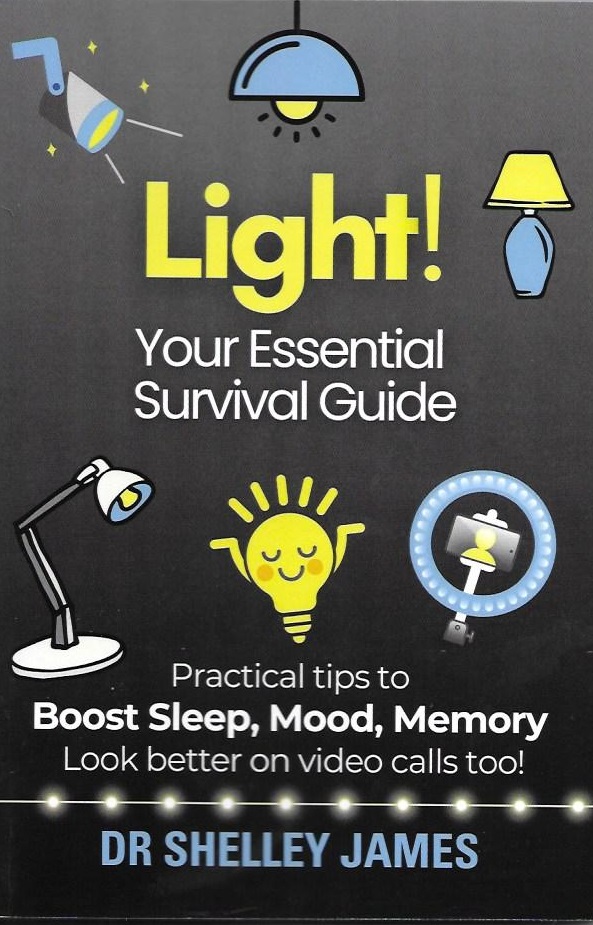
By the way, if you want to learn more about this, then Shelley’s book Light! Your Essential Survival Guide is an excellent place to start.
I wrote a review last year: see it here