

Recolight has launched a new in-depth workshop that explains LCAs (Life Cycle Assessment) and EPDs (Environment al Product Declaration), tailored specifically for lighting products, continuing to make inroads into the nature and quality of lighting specification, stretching its own remit in the process!
.
Before we start to think of Recolight as a think tank for sustainable and environmentally-sound manufacture let’s not forget that this is a company that actually gets its hands dirty in its core role of managing a WEEE compliance scheme and advising its membership on the best ways to ensure that luminaires and lamps find their way into the recycling stream and are kept out of landfill.
The management team, led by Nigel Harvey, understood very early in the process (Recolight began its operation in 2007) that the route to the recycling plant wasn’t necessarily the best – or only – way to ensure lighting materials didn’t end up in landfill.
This latest workshop series is a further development beyond the Circular Design processes that Recolight has been promoting via the Circular Lighting Live conferences and ongoing series of webinars. The argument seems to go that, if a company is to make products with a decent circular pedigree, it makes sense to bring those products to market with full and proper credentials – and that means promoting an understanding into how manufactured equipment will function across its lifetime and what goes into the fabrication processes.
The LCA / EPD workshops are run by Max Robson PhD, Recolight’s new Environmental Metrics and Training Manager. Max was awarded a PhD in chemistry from University of bath, having worked on the fabrication of thin film semiconducting metal chalcogenides, primarily using chemical vapour deposition techniques.
No – me neither.
Let’s start with a couple of definitions:
Life Cycle Assessment:
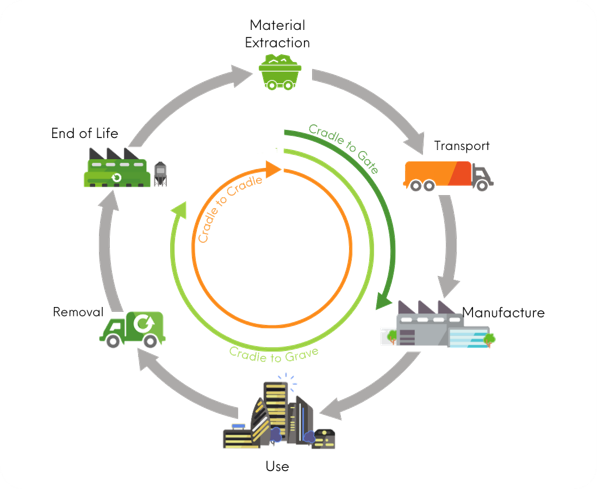
The European Environment agency (EEA) defines LCA as a process of evaluating the effects that a product has on the environment over the entire period of its life, thereby increasing resource-use efficiency and decreasing liabilities.
Environmental Product Declaration:
According to Wikipedia, and EPD is a declaration that quantifies environmental information about the life cycle of a product. This can enable comparisons between products fulfilling the same function.
I guess that, put into the lay-est of lay terms, we know that everything that we make comes with a cost; in material, labour, and in energy. If we can measure those costs in respect of the environment in addition to their financial cost, then we can see how much of our planet we’re putting into our products – whether we’re the maker, the user, or the disposer. It’s a different kind of quantity surveying; that is all.
.
I attended the first workshop at BDC, London, hosted by Tridonic.
I first heard about LCAs and EPDs about fifteen years ago and there was a commonly-repeated quote at the time from Brian Boyd, VP Worldwide Environment, Health and Safety, Johnson & Johnson:
“Can anyone think of a more complex and all-encompassing ‘business issue’ than the concept we now know as ‘sustainability’? I can’t. So it’s no surprise to me that ‘how we measure it’ is going to evolve and vary’.
And as Max guided us through the flow charts and the graphs, I was reminded of something that Kevin Jones, my lecturer in Illuminating Engineering at Wolverhampton Polytechnic told us back in 1974: ‘A good guess is usually sufficient’.
For many of us, the process of delivering LCAs and EPDs is still ‘complex and all encompassing’. But the word that we heard most often from Max during the workshop was
carbon
And by ‘carbon’ what we actually mean is ‘greenhouse gases’ that include carbon dioxide, nitrous oxide, methane, and a bundle of industrial gases. Water vapour and ozone are also greenhouse gases, though they have beneficial effects that outweigh the potential harm that they can do, so are usually ignored for these purposes.
The early discussions around global warming spoke of the impact of greenhouse gases, but there wasn’t the critical understanding then of the overwhelming damage to our environment that they we now see around us. We can argue then that the ‘complex and all-consuming business issue’ is now sufficiently existential that we have to find the head-space to incorporate the impact of our activities into our daily working (and personal) lives.
So, while Life Cycle Assessments are about more than Carbon, the underlying purpose is to quantify global warming potential as well as other environmental impacts (biodiversity, for example)
Max tells us that there are four steps to a Life Cycles Assessment:
- Define the goal and intended Scope of the LCA
- Collect the life cycle inventory data
- Conduct the LCA
- Interpret and publish the results of the LCA
.
The Life Cycle Assessment will provide the manufacturers with figures relating to both embodied carbon (what carbon is produced in the manufacturing process) and operational carbon (what carbon is produced when the fixture is in use)
As we push towards Net Zero working, these figures are essential and it’s not difficult to imagine how project specifications requiring carbon production within product specification will only become more familiar to us.
.
The Environmental Product Declaration
EPDs start with the LCA exercise and then dives deeper into the environmental impacts identified in the LCA.
There are four types of EPD:
- Third party EPD, which is valid for 5 years, which is the ‘standard’ type of EPD
- Project-based EPD, valid for 12-36 months and is specific to a project and where the information is not publicly available.
- Average EPD, which is valid for 5 years and is used to evaluate similar products serving the same function. Only five ‘lighting industry average EPDs’ are currently in progress.
- Design phase EPD, pasts for only 18 months and is used for newly-released products where there is insufficient production data.
EPDs are becoming more important for a number of reasons, most importantly that they will help manufacturers to meet new regulations.
UK Net Zero Carbin Building Standards
Energy Performance of Buildings Directive
Ecodesign for Sustainable Regulations
Voluntary standards (BREEAM, for example)
Customer’s Regulations (requirements of new EU regulations)
There is an inevitability here that lighting manufacturers will have to embrace the world of LCAs and EPDs, if only to maintain their market position. And in the short – medium terms we can think in terms of improving market position.
EPDs are held in specialist online libraries and that will become a first stop for lighting specifiers. This runs against the grain, where most of us know what we need to do a job and would prefer to stay with what we know, but that doesn’t cut any ice if those products don’t have the necessary credentials to back them up.
And the reason it cuts no ice is that we’re – ultimately – not the ones making the decision. The transparency of data within an EPD assists in the tendering and procurement stage to ensure ‘sustainable product selection’ – whatever that may mean for the project instigator.
.
There isn’t a manufacturer in the land who doesn’t need to understand the implications for LCAs and EPDs on their business. Whether you decide to take up the challenge – and it will be a challenge – to embrace this new kind of quantitative measurement or not, its vital that we all appreciate the reaoning behind all of this.
And – really – it’s not being done just to annoy you.
.
To learn more about LCAs and EPDs, join in one of Recolight’s workshops.
.
.
