

.
In a few days we’ll see the first conference dedicated to the concept of Responsible Outdoor Lighting At Night (ROLAN). This inaugural conference has been organised by SLL and ILLUME of Gdansk university of Technology in Poland.
Its ‘s an online conference, over two days, with a wonderful line-up of speakers. If you have anything to do with exterior lighting, then get registered and block out your diary for next Thursday and Friday, 12th and 13th May 2022.
The Light Review is happy to be a media partner for the event and we’ll be commenting on the conference as we go.
.
You can REGISTER for the ROLAN conference by clicking here.
.
- All of which begs the question, do we need exterior lighting at all?
- A daft question, I hear you reply – where would we be without it?
- Well, we’d certainly all be in the dark . . . but is that such a Bad Thing?
.
Let’s take a step back and consider the issue from a greater distance – say, from the moon.
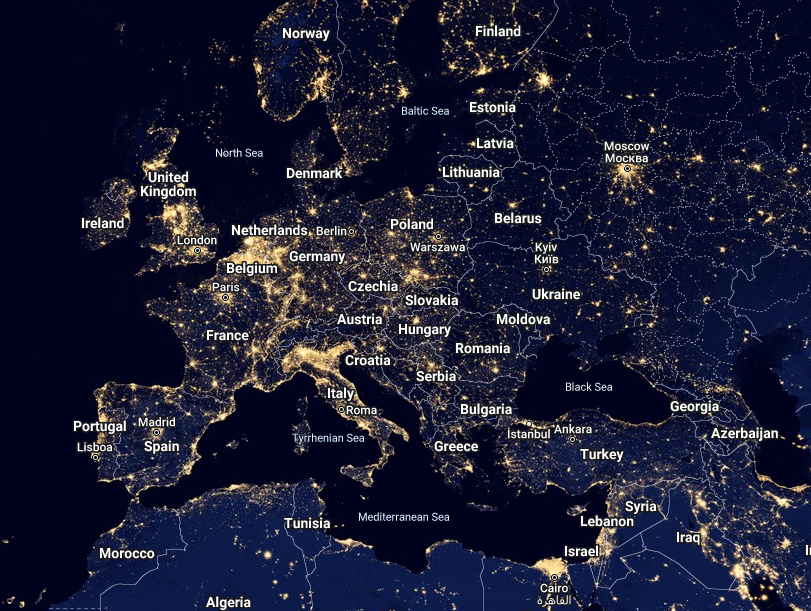
The human race, being the most adaptable creature on the planet, has evolved to become the self-proclaimed dominant species and, for sure, there are a lot of extinct species who’d agree with that. And wherever we go, we create a luminous spoor all around us. We learned how to create light (thanks, Prometheus, for that fire hint – it came in very handy) and as soon as we had rotary power under control we trapped light in a glass bubble. Amazing!
Its only in this past decade that our use of energy has really been questioned as to it’s actual benefits. Obviously, it’s benefitted us – though we have a great propensity for ignoring any bad stuff that might be happening to our friends and neighbouring species. Isn’t it time that we took a more absolutist viewpoint on the issue of lighting our Dark. What do we think we’re doing – what are we scared of?
The ROLAN Conference will play a vital role in addressing the hows and whys of night-time lighting, but I don’t see anyone on the programme who’ll be arguing to switch it all off. Even those who come close, and I’m pointing a respectful torch at you, Mark Major, accept that we need some night-time illumination. I’d like to hear from a fundamentalist that argues for no lighting at all.
What might that fundamentalist say?
I’d start by asking that most basic of questions; why do we need it in the first place? If we start by assuming that it’s our right (as dominant species . . . etc etc) to do what we like, then eventually we forget to ask whether something is a good idea. And the more we believe our own hype, the farther we get from the reality of living on a globe where half of it is always in some state of darkness. We come to accept a kind of enhanced reality, where artificial light is as ubiquitous as air and water. Remember that thought the next time you experience a power cut. Anything that is human-made is precarious; it can fail. And sometimes it should fail.
Why do we light?
- we light for vanity: My edifice is bigger than your edifice and I can shine a light on it to prove it.
- we light for control: I demand the right to surveil my environment and I need light to do that.
- we light for profit: I need my clientele to see me and my works.
- we light for fear: I cannot go about if I can’t see what’s around me .
- we light because we can: I might spend my evenings indoors, but I can go out and about should I ever choose to.
There’s a common theme running through that list, and it shouts URBAN! The entire argument about needing light comes from the urban community. The scene is very different in the countryside. City folk say that they’re scared of the countryside because of the darkness; I get that. It’s quite a leap to go from illuminated streetscapes to a place where it’s so dark that you can experience a shadow cast by the planet Venus. (believe me, that’s quite a trip!). But it also means that you can walk around by the light reflected from Venus.
Life in rural communities does go on. We find our ways around with surprising ease. How? Because night-time lighting is incidental; you might want to call it ‘a torch’. Vehicles are also fitted with torches that enable us to dodge trees and other local fauna, and we don’t see the need to illuminate buildings so much. A few churches on the tourist routes, maybe, but they tend to be under the control of the traditionalists who believe that man was given dominion over all the earth, so that argument might take a little longer.
Is this a crack in the fundamentalist argument for NO LIGHT?
If acknowledging that we need some light to get around, rather than stumbling around in total darkness, arms outstretched (I tried that – it doesn’t work) is back-sliding, then guilty as charged. But what I am still saying is that we can halt the use of institutional and formal night-time lighting. I come abck to Mark Major’s article in the ROLAN Conference special issue of SLL Light Lines . . . EVERYTHING MUST CHANGE.
For starters, perhaps lighting designers could take a position and agree not to undertake any exterior lighting schemes unless clients sign-up to a ‘NO LIGHT’ DESIGN POLICY. That’s a lighting scheme that I’d like to see.
.
While we’re waiting for that to happen, don’t forget to register for next week’s ROLAN Conference 2022.
You can REGISTER for the ROLAN conference by clicking here.
..

.
And you can read the official announcement from the conference organisers HERE:
.