

How often have you been caught in a moment, looking into space, and are asked what you’re thinking about? Most of the time our hectic lives leave little time for introspection, or just the ability to switch off, and – well – just observe. Unfortunately, sometimes I fill this void with . . . dreams and flam. I do wonder sometimes where the multi-coloured imagination of my childhood went.
The childhood of Yayoi Kusama must have been a time of some difficulty. Born in Matsumato, Japan in 1929, it was a time when Japanese traditions and conservatism were strongly promoted. Making art as a child was discouraged by her family, and from early on in her life she experienced visual hallucinations. In one childhood memory she recalls:‘
One day after gazing at a pattern of red flowers on the tablecloth I looked up to see that the ceiling, the windows, and the columns seemed to be plastered with the same red floral pattern. I saw the entire room, my entire body, and the entire universe covered with red flowers’. She felt as if she was disappearing or dissolving. She describes this as ‘self-obliteration’. Using experiences like this in her art is a way for her to make sense of them and share them with others.’
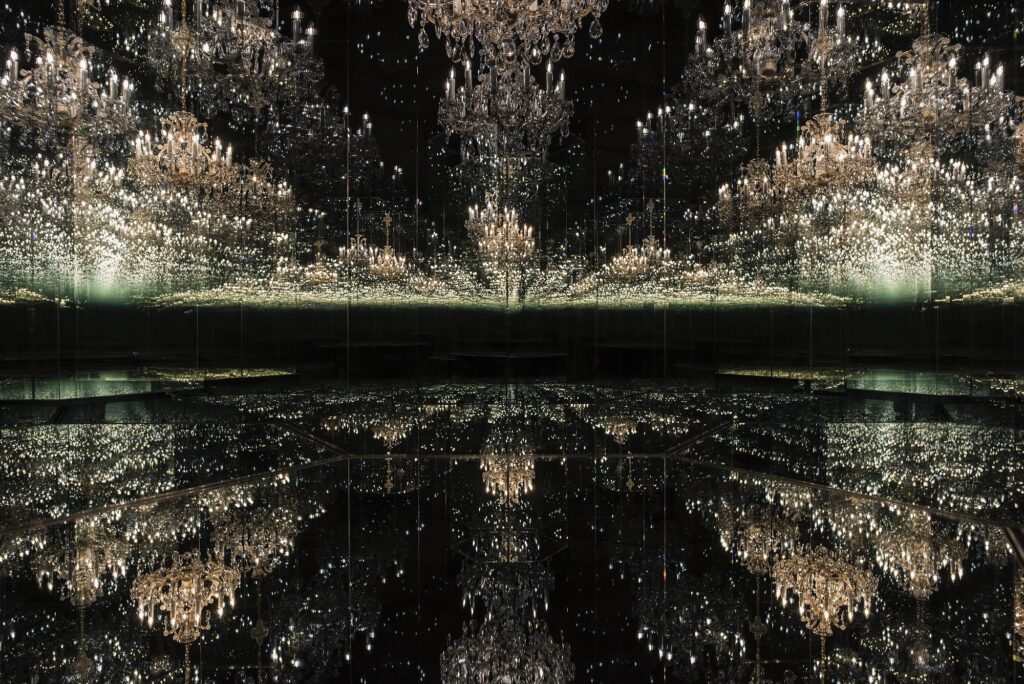
This exhibition is comprised of two immersive mirror rooms, the ‘Infinity Mirrored Room – Filled with the brilliance of Life’, ‘The Chandelier of Grief’, and ‘The Universe as Seen from the Stairway to Heaven’ a peep-in sculpture. There are also displays of film and photography, which are worth sitting down and absorbing (it puts the journey of her work into context). For example, in ‘Mirror Performance’ Kusama is shown working in 1960’s New York at a time before her worldwide fame; when she was struggling for recognition, or even to make a living. You can only admire her belief and drive. The last time I looked at buying tickets online there was a queue of over 10,000 people waiting alongside me!
© YAYOI KUSAMA Courtesy Ota Fine Arts and Victoria MiroPhoto © Tate (Joe Humphrys)
In the first room, standing in front of ‘The chandelier of Grief’ I felt like I was in a Stanley Kubrick film, waiting to be interrogated; a rotating pendant shines and sometimes flashes, whilst housed in a glass cabinet. The piece is massively photographable, instagrammable. Standing inside the space you feel a little disorientated, as the light reflects and changes in the infinity mirrors. The piece is beautiful in its starkness.

Tate: Presented by a private collector, New York 2019 © YAYOI KUSAMA
Courtesy Ota Fine Arts and Victoria MiroPhoto © Tate (Joe Humphrys)
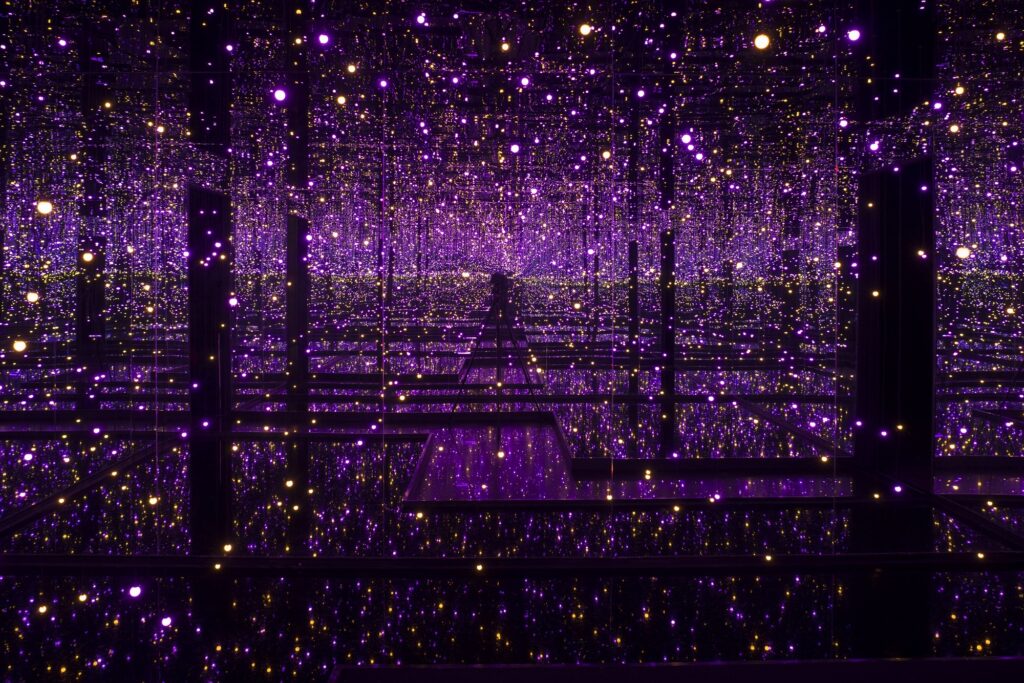
In comparison ‘Infinity Mirrored Room – Filled with the Brilliance of Life’ (2012 retrospective exhibition Tate Modern) is just one of those spaces that, when you step in you just say, Wow! Constantly bombarded by computer augmented reality, within a physical space that feels like you are inside someone else’s dreamscape. A strange and pleasant detachment from reality.

Tate : Presented by the artist, Ota Fine Arts and Victoria Miro 2015, accessioned 2019
© YAYOI KUSAMA Photo © Tate (Joe Humphrys)
As the coloured LED lights (hanging from the ceiling) changed in intensity and colour, I felt quite at peace as they disappeared into infinity, reflected in the shallow pool and mirrors. Kusama’s pieces often put the viewer into the art, and you leave wishing that you could spend more time inside. In a perfect world every company would be obliged to have these in their offices as a break-out space!
Tate: Presented by the artist, Ota Fine Arts and Victoria Miro 2015, accessioned 2019
© YAYOI KUSAMA Photo © Tate (Joe Humphrys)


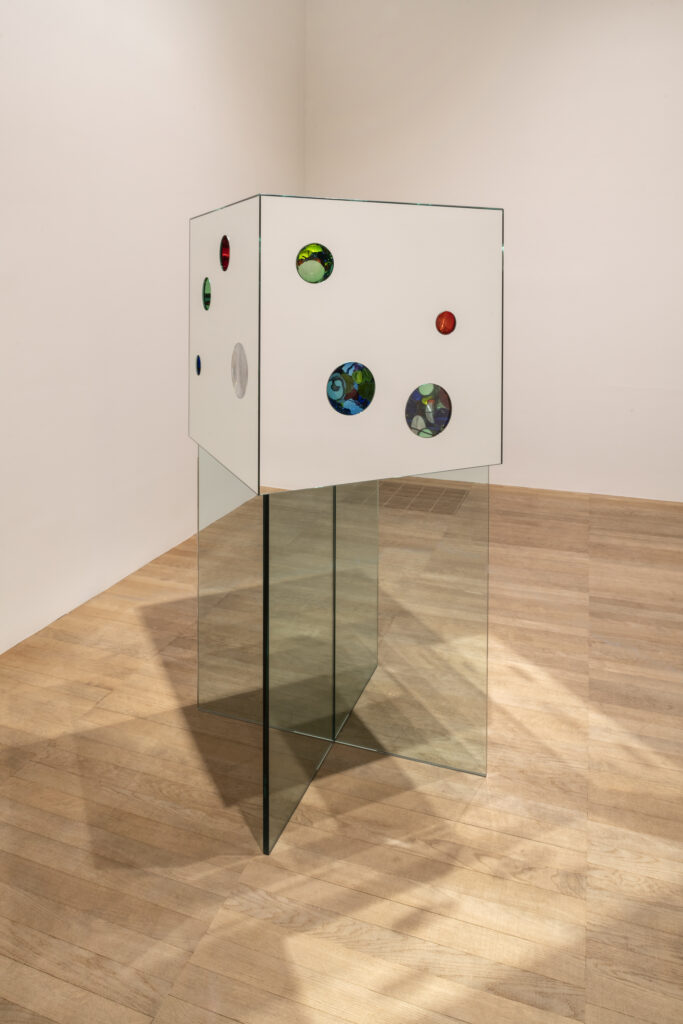
It was harder to gauge the full effect of ‘The Universe as Seen from the Stairway to Heaven’ (2021) as I wanted to press my nose to the glass and look inside, but visitors were asked to keep a short distance from the sculpture, (in retrospect, that’s probably a good idea in these Covid days – and the fact that it did look quite fragile perched on a plinth).
Courtesy the artist, Ota Fine Arts and Victoria Miro
© YAYOI KUSAMA Photo © Tate (Joe Humphrys)
Inside you glimpse a space that seems infinite, with faces including your own reflected alongside coloured circles, a theme that has long been an important aspect in Kusama’s work.
For Kusama, as in our lighting world, the experience is often more than about looking, but being immersed in. The exhibition is a relatively small one, and I do wonder whether the £10 entrance fee is justifiable, given the wait to obtain tickets (sold out until April), the relatively short period of time you can spend in the rooms, and the queues.
But that said, since the 90’s she has been a global brand, and her work is quite unique. As the Editor of ‘The Light Review’ has pointed out, it’s probably no more than a cinema ticket, for what is a real life wonder. So for those of you lucky enough to have booked your tickets, once you’ve blitzed your Instagram and Facebook account with some eye candy, it could be worth queuing inside twice if they allow you, switch off, and – well – just observe and absorb.
.
MENTAL HEALTH RESOURCES
Yayoi Kusama’s experience of mental illness has been an important influence on her art. The following organisations can provide support if you are experiencing problems with your mental health.
- Rethink Mental Illness Advice and Information Service provides practical advice and information on a wide range of mental health topics. www.rethink.org Hearing Voices
- Network offers support if you hear voices, see visions or have other unusual perceptions. www.hearing-voices.org
- Samaritans will face it with you, whatever you’re going through. Available 24 hours a day, 365 days a year. www.samaritans.org
.

Tate Presented by the artist, Ota Fine Arts and Victoria Miro 2015, accessioned 2019
© YAYOI KUSAMA Photo © Tate (Joe Humphrys)